Basic
290 zł
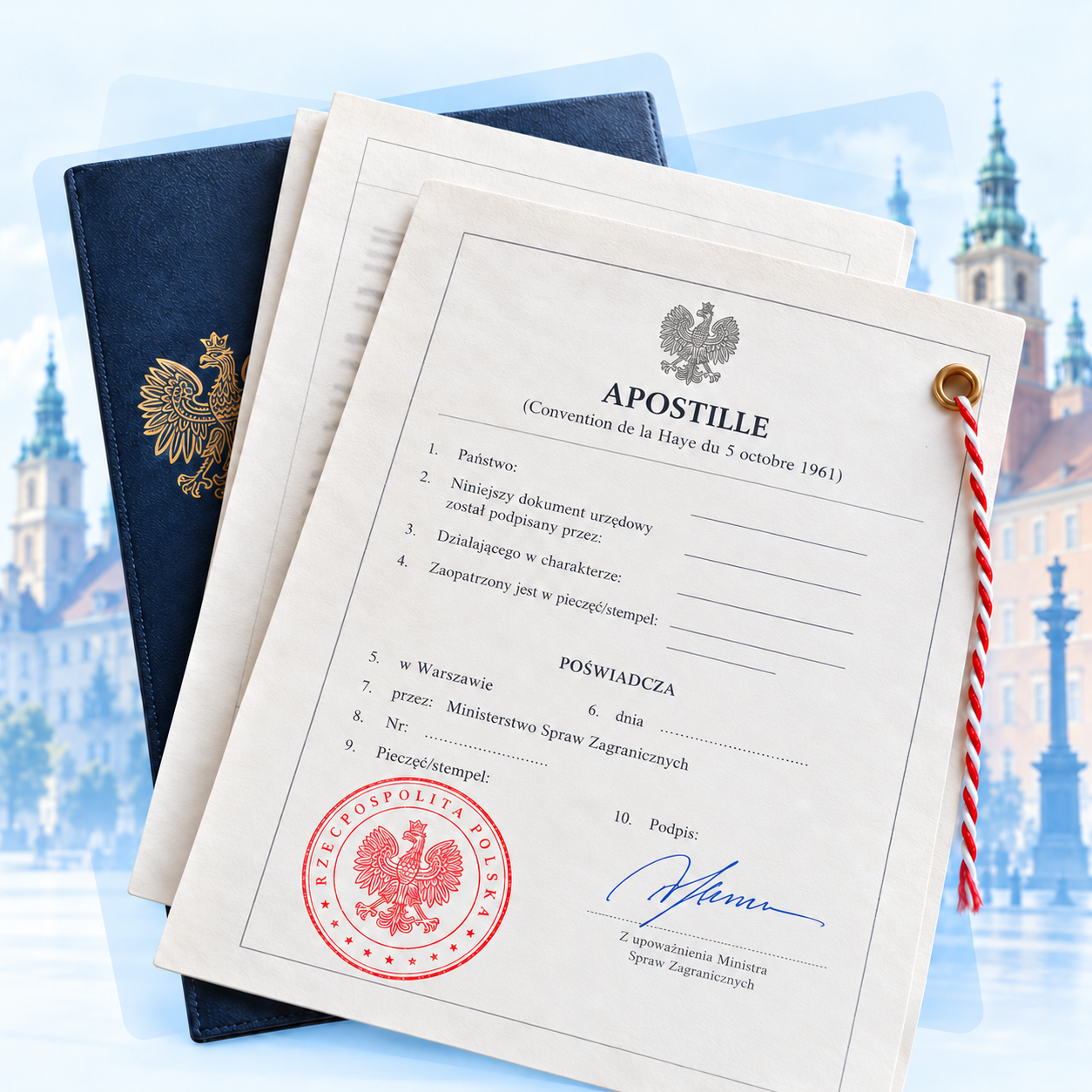
Order an apostille
✓Submission to the Ministry of Foreign Affairs
✓Obtaining the apostille
✓Official fee of 60 zł included
Prices cover one eligible document at the MSZ stage. The PLN 60 official fee is included.
3–4 business days, 2 business days and 24 hours refer to the selected MSZ stage. Obtaining a court copy, prior authentication, translation and additional postage are agreed separately. Overall timing includes preparation, the necessary steps and receipt of the result.
We’re always available—contact us conveniently via WhatsApp, Telegram, and other messengers. We respond quickly and keep you updated at every stage.
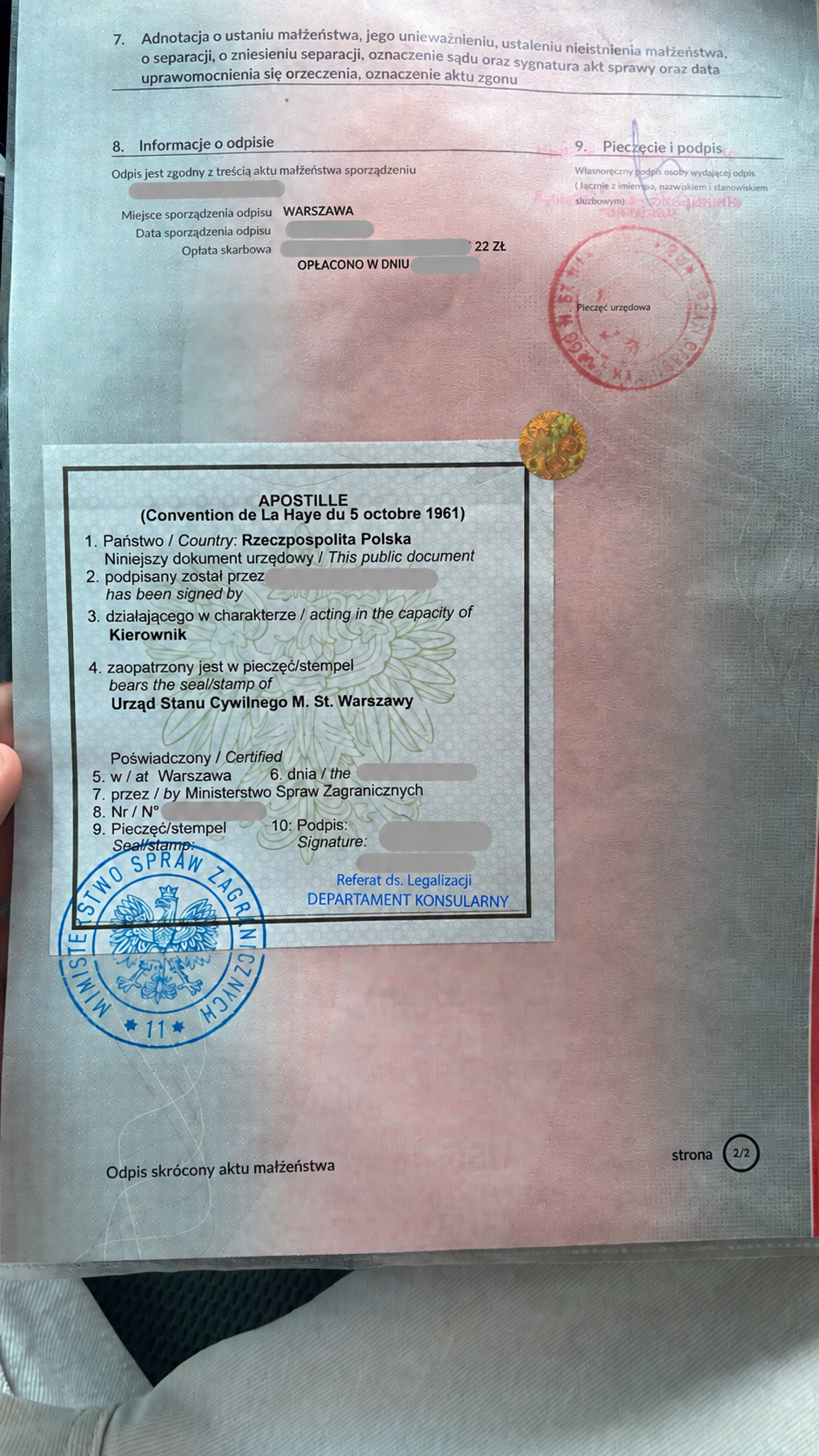
Birth certificate apostille
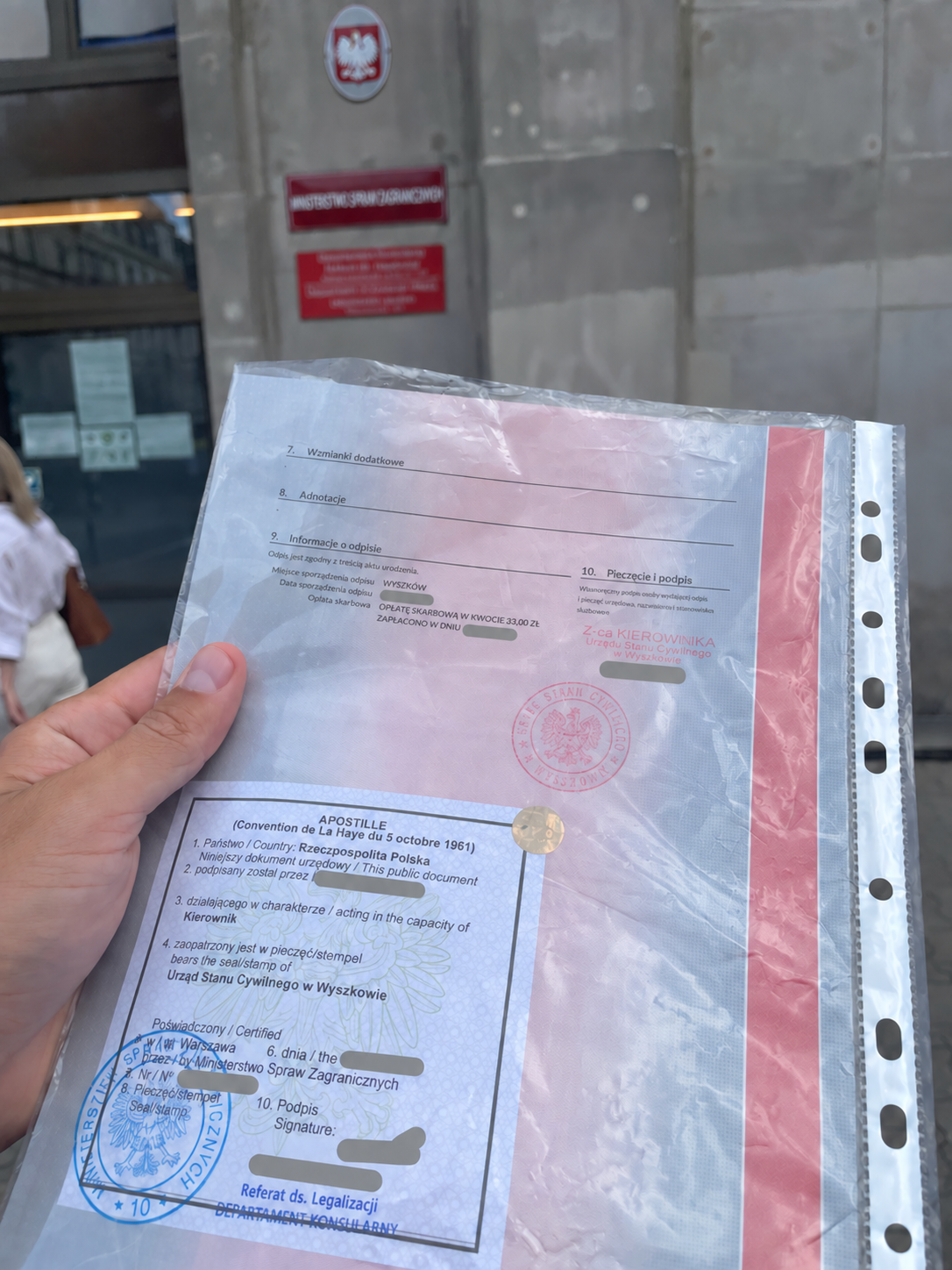
Apostille on a notarised copy
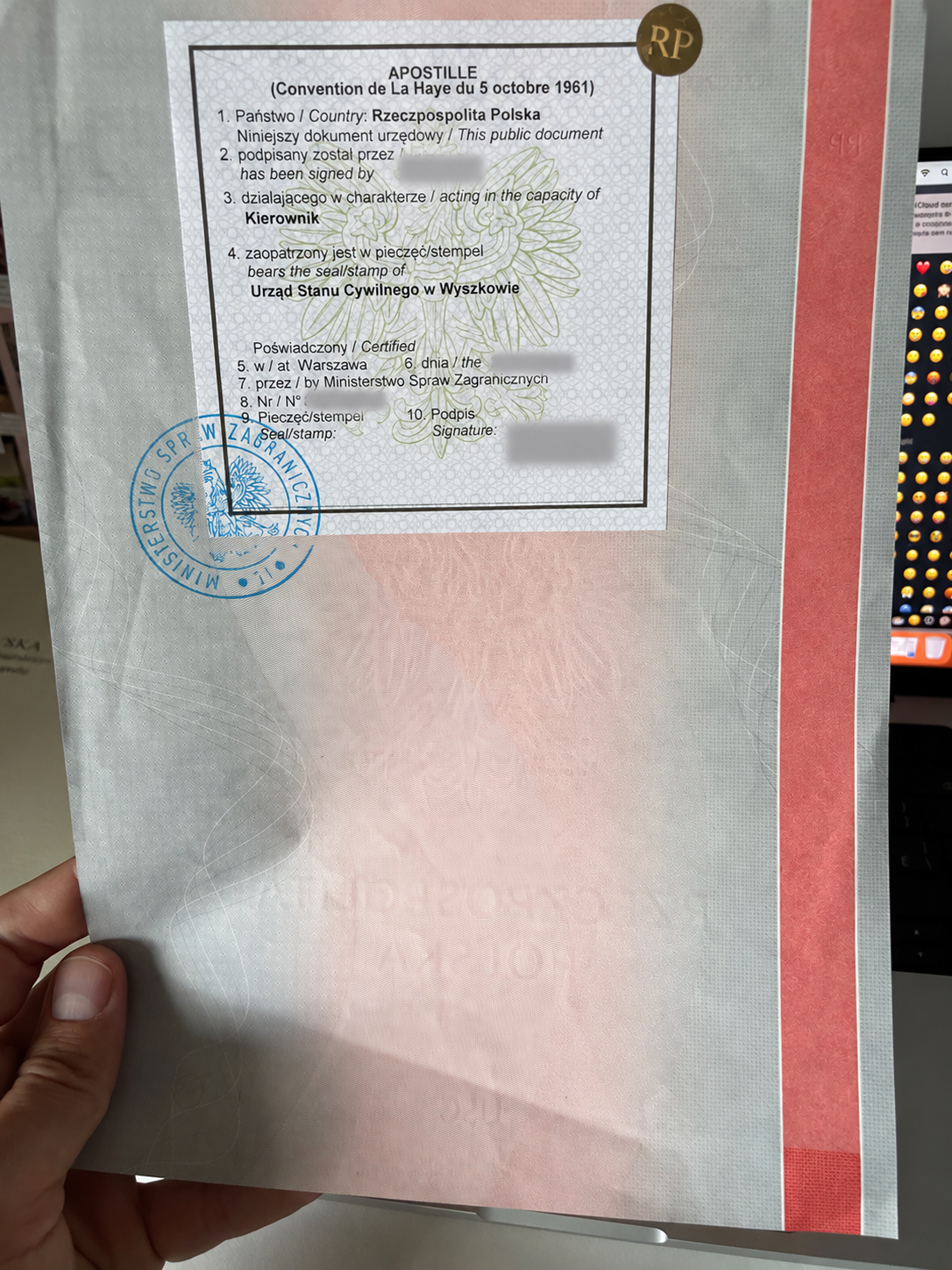
Marriage certificate apostille
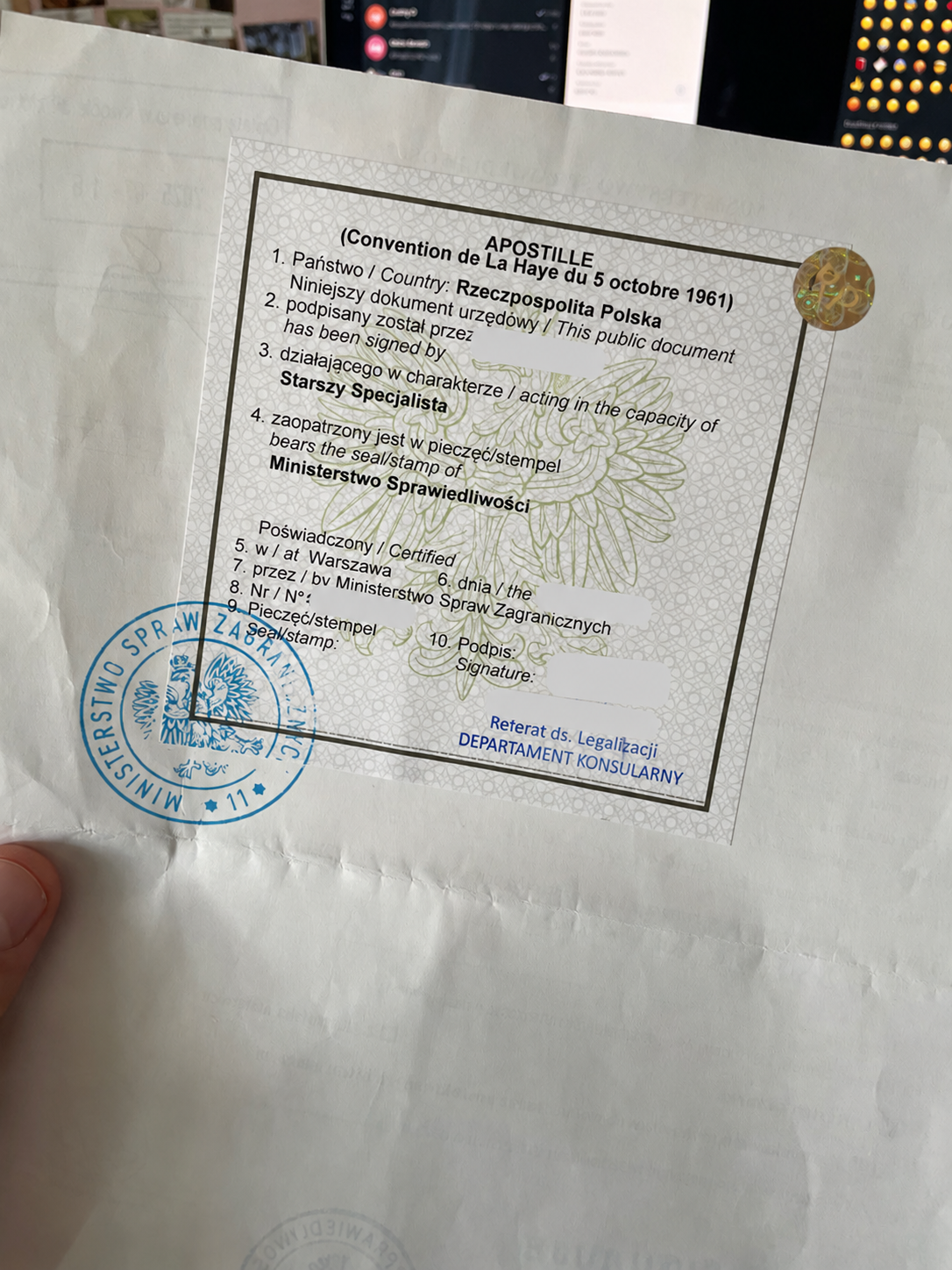
Criminal record certificate apostille
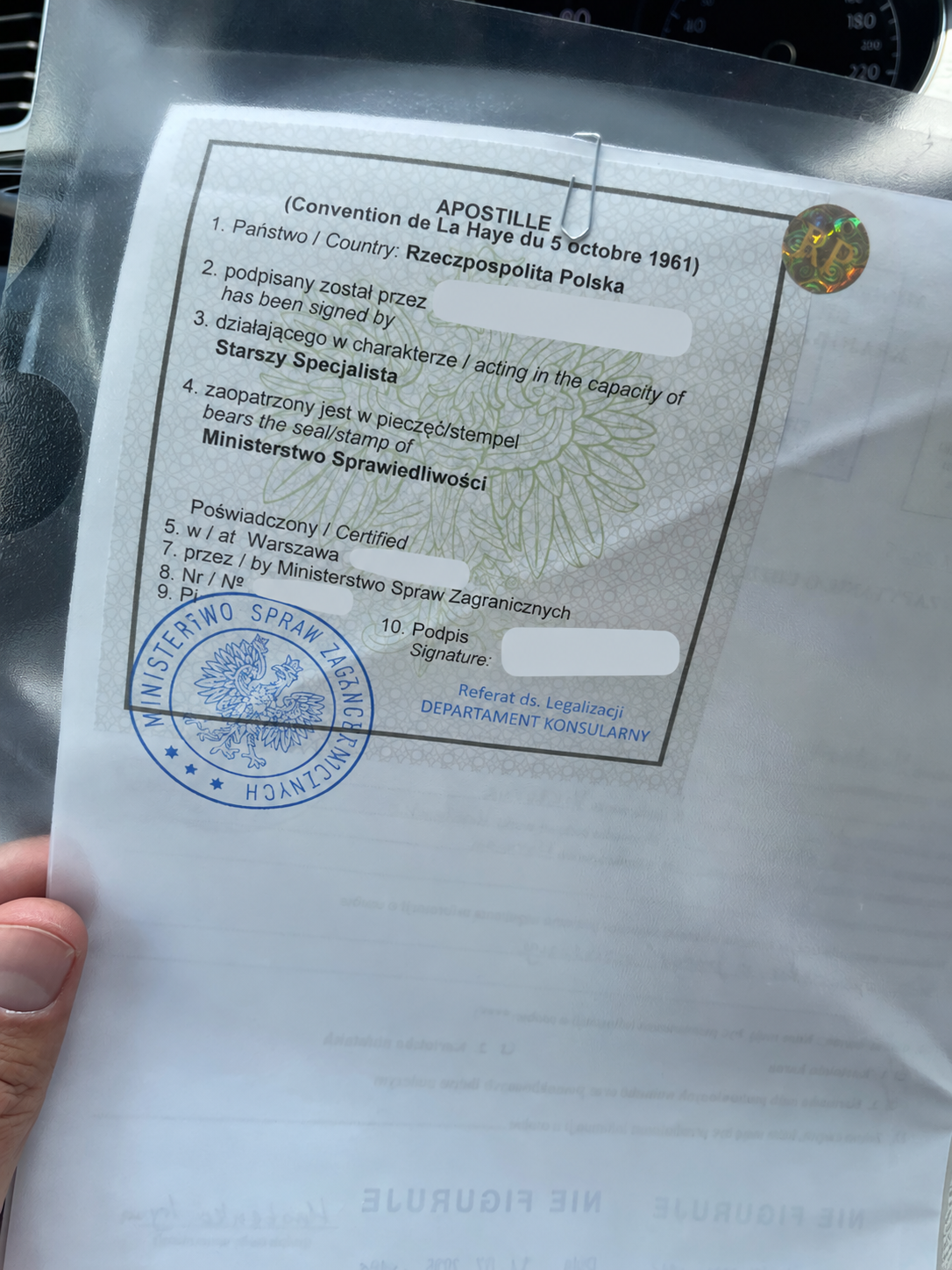
Court judgment apostille
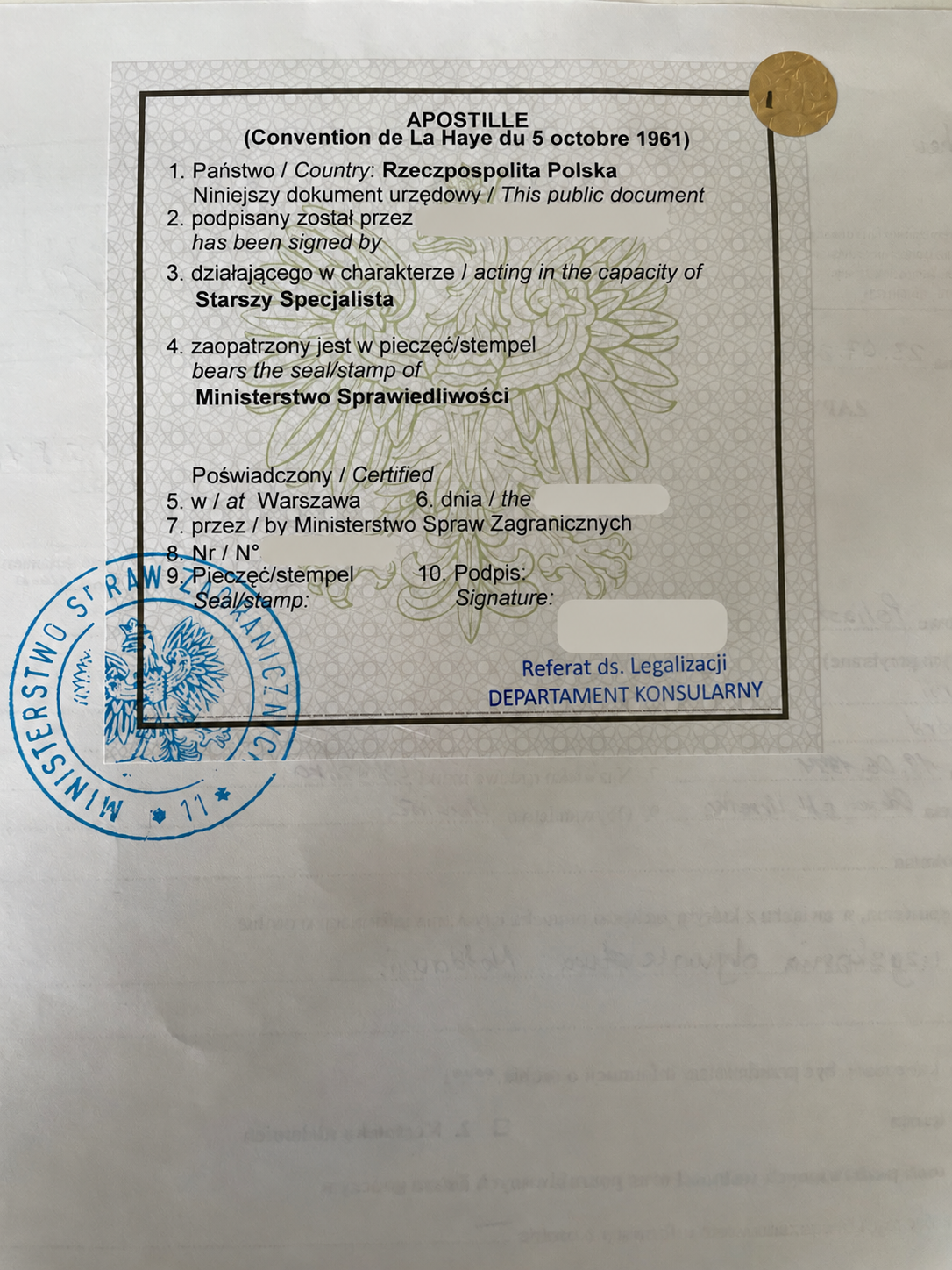
Apostille on an official document
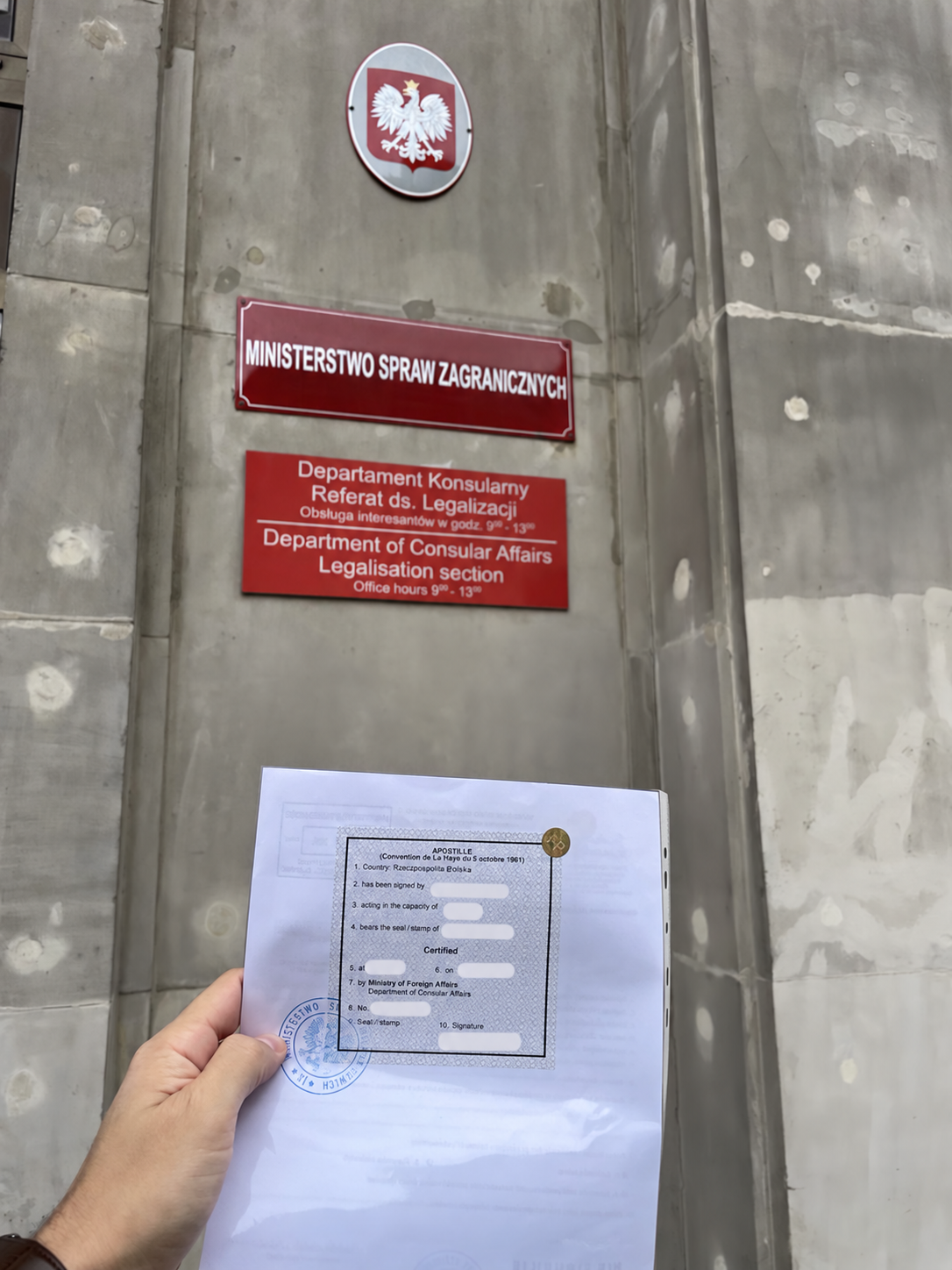
Criminal record certificate apostille
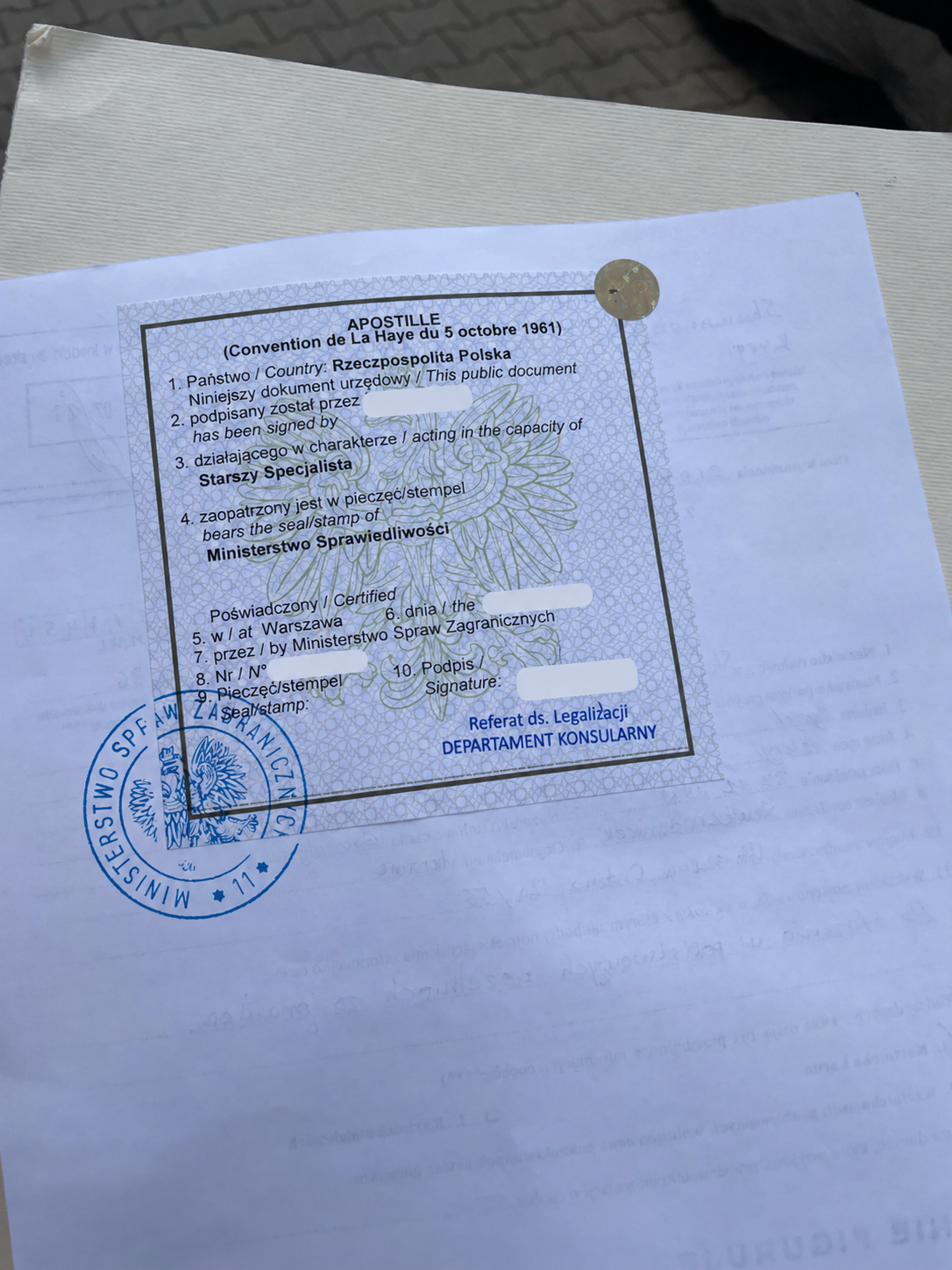
Notarial power of attorney apostille
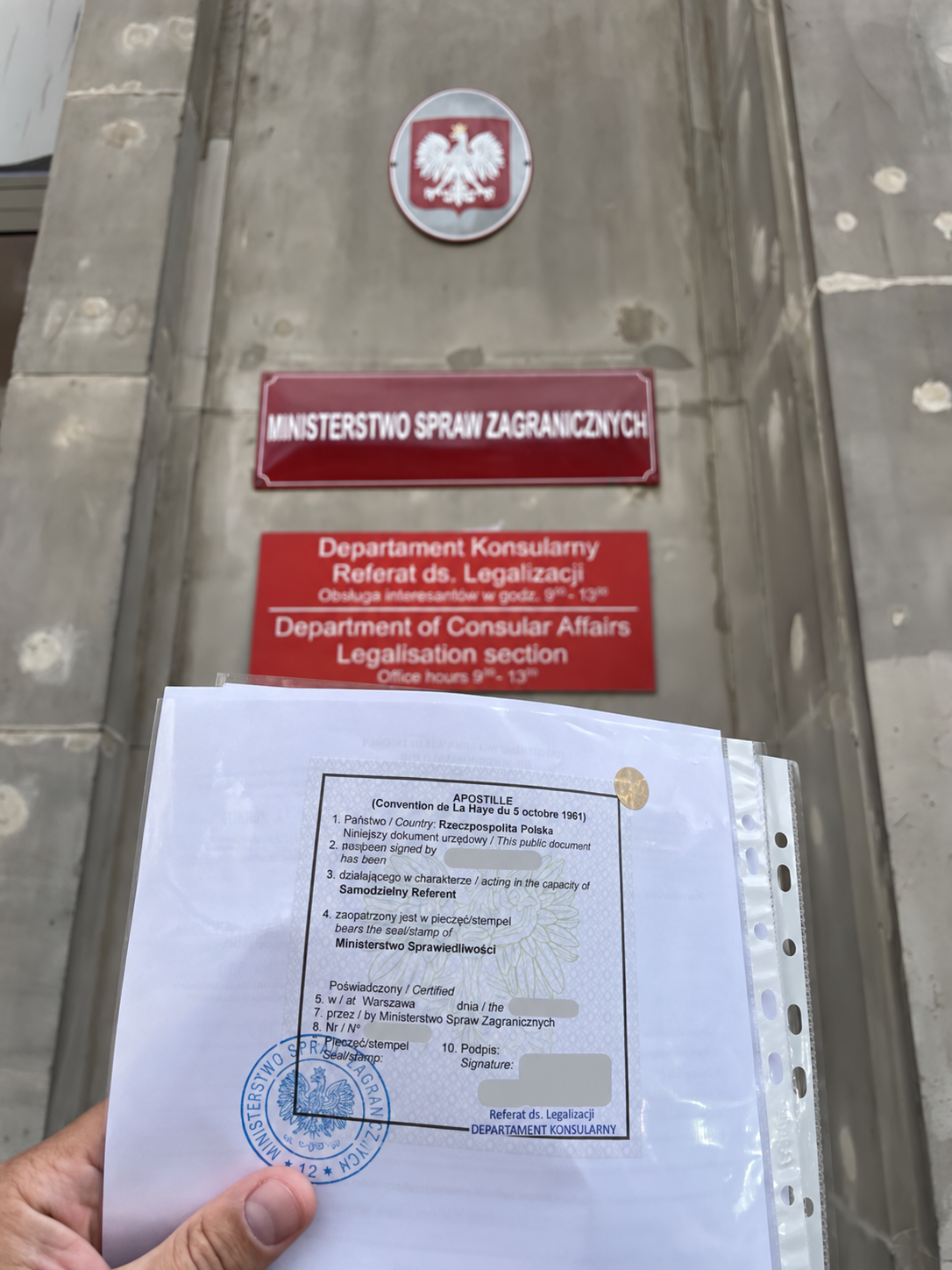
Example of an apostille on a client's document
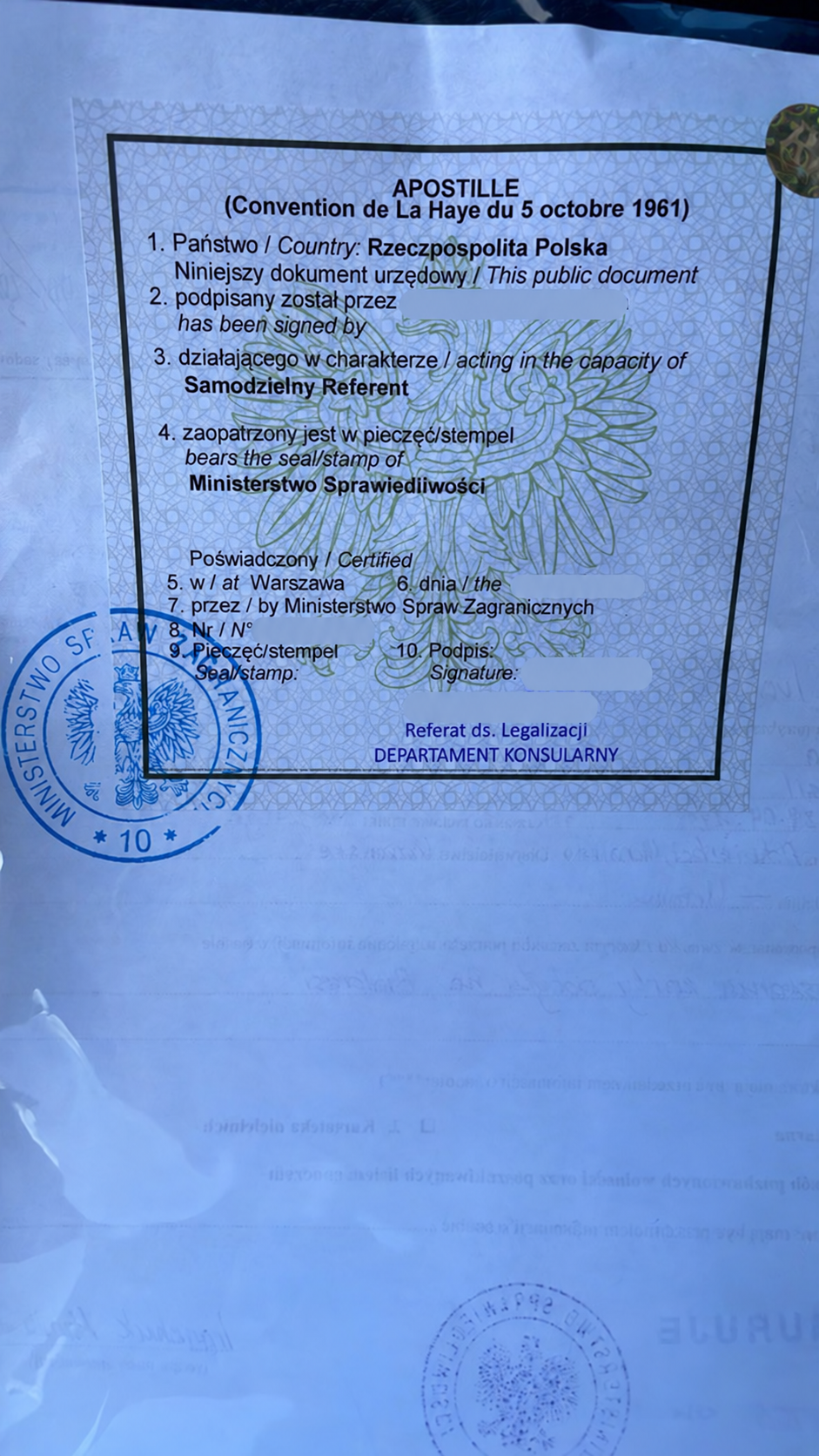
Example of an apostille on a client's document
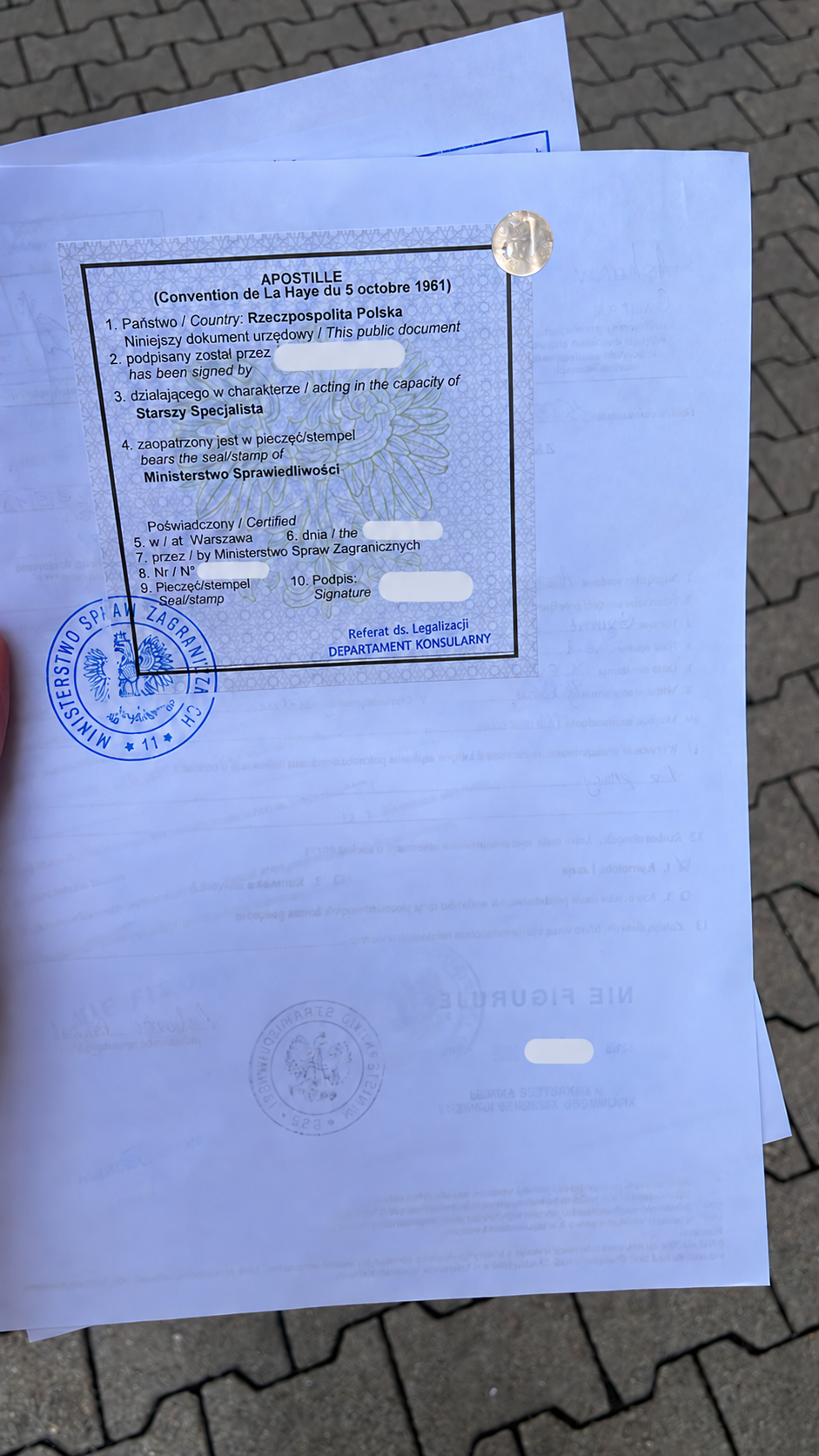
Example of an apostille on a client's document
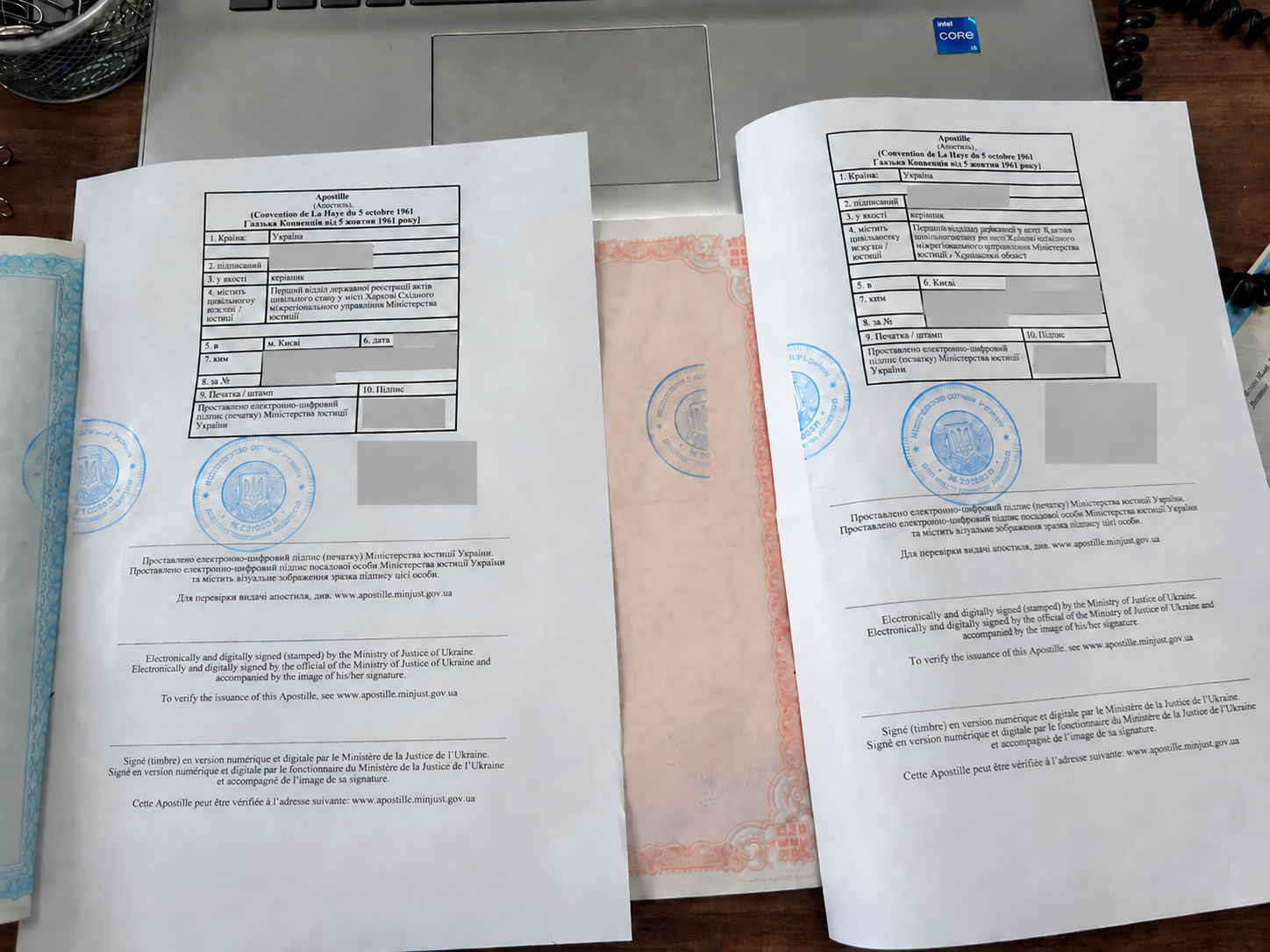
Example of an apostille on a client's document
I needed to do an apostel urgently, the guys helped me do it in one day, I can recommend it
I ordered police clearance certificates with an apostille for two people, applied on Thursday, and everything was rea…I ordered police clearance certificates with an apostille for two people, applied on Thursday, and everything was ready on Monday. The original can be obtained in Poland through Inpost, they also send a high-quality scan. Very convenient and fast! Thanks a lot!
I contacted the Translait Service office to obtain an apostille for the document. The bureau employee answered me very…I contacted the Translait Service office to obtain an apostille for the document. The bureau employee answered me very quickly. The quality of service is at the highest level. The staff is very attentive. The apostille was issued exactly on time. I recommend contacting this office
There are professionals who know how to help, where to start. In five days everything was done and sent to Ukraine. Thank…There are professionals who know how to help, where to start. In five days everything was done and sent to Ukraine. Thank you so much. I applied for an apostille and obtaining a duplicate birth certificate. Being in Ukraine, all this had to be done in Poland.
Hello! I ordered a police clearance certificate with an apostille. The next day I was ready. DHL delivery to Kazakhstan…Hello! I ordered a police clearance certificate with an apostille. The next day I was ready. DHL delivery to Kazakhstan took another six days. This is great! To be honest, from the very beginning I didn’t really believe in this event, but the impossible is possible! Great!!!
I contacted this company for the first time. I ordered a police clearance certificate in Poland with an Apostille. Very…I contacted this company for the first time. I ordered a police clearance certificate in Poland with an Apostille. Very competent staff. Everything was done quickly. Received excellent advice on all issues. Sent by mail. I recommend it.
Initially, I was worried that I had contacted scammers, but in the end everything happened in the best possible way, eve…Initially, I was worried that I had contacted scammers, but in the end everything happened in the best possible way, everything was quick and clear. valuable, of course they bite a little, but everything else is top notch
The order was completed in the shortest possible time, I am very pleased.
Great company! Everything was done quickly and at a good price. Thanks for your help with the documents.
Everything went well and quickly. I liked the service. My issues were resolved in one day. Thank you 💕...
Start with a question or description of your task, even if some requirements are still unknown. The full package and terms are clarified after contact, before the necessary work.
| Receipt question | What matters |
|---|---|
| Representative and notary | Written authorisation is provided for the described MSZ submission cases. Signature authentication involves the signatory; this is not necessarily the client. |
| Postal return from MSZ | The authority returns documents by registered post to Poland, the EU, Iceland, Liechtenstein, Norway and Switzerland. Other destinations require a Polish address for an authorised recipient of correspondence; onward dispatch by the company is agreed separately. |
| Additional requirement or rejection | Keep the recipient’s exact reason and requirement. Completing the package, correcting a translation, refunding official duty and refunding company payment involve different grounds; an apostille does not guarantee acceptance. |
Written authorisation is provided for the described MSZ submission cases. Signature authentication involves the signatory; this is not necessarily the client.
The authority returns documents by registered post to Poland, the EU, Iceland, Liechtenstein, Norway and Switzerland. Other destinations require a Polish address for an authorised recipient of correspondence; onward dispatch by the company is agreed separately.
Keep the recipient’s exact reason and requirement. Completing the package, correcting a translation, refunding official duty and refunding company payment involve different grounds; an apostille does not guarantee acceptance.
Details of agreement and collection or delivery
Remote contact does not mean every act can be completed without the required documents, authorisation or signatory’s involvement. There is no general requirement for a notarised power of attorney for every MSZ submission; the authorisation needed is checked against the submission method. MSZ: submission methods, Notarial Law, Article 88.
The authority’s document return rules are described in the MSZ FAQ. Refund of official duty is separately governed by Article 9 of the Stamp Duty Act; it does not establish a refund of the whole order price following rejection abroad.
A document package may involve different authentications. First identify the object: the sworn translator’s signature, the original document, or a particular notarial act.
| What to check | Conditions |
|---|---|
| Object and authority | The signature, capacity of the signatory and seal of the Polish sworn translator; the procedure described here goes to Poland’s Ministry of Foreign Affairs — MSZ. The apostille itself does not certify translation accuracy. |
| Countries | The translation was actually prepared in Poland for use abroad. The original may be Polish or foreign. A translation prepared in another country needs a separate procedural check: Polish professional status does not establish where it was prepared. |
| Document form and preliminary steps | The paper procedure requires a properly executed translation. A photocopy of the signed translation is unsuitable. There is no general preliminary court authentication stage for this route. |
| Exemptions and recipient | Check the translation separately against the destination country, institution, procedure, language, source and form. This authentication does not satisfy requirements for the foreign original automatically. |
The signature, capacity of the signatory and seal of the Polish sworn translator; the procedure described here goes to Poland’s Ministry of Foreign Affairs — MSZ. The apostille itself does not certify translation accuracy.
The translation was actually prepared in Poland for use abroad. The original may be Polish or foreign. A translation prepared in another country needs a separate procedural check: Polish professional status does not establish where it was prepared.
The paper procedure requires a properly executed translation. A photocopy of the signed translation is unsuitable. There is no general preliminary court authentication stage for this route.
Check the translation separately against the destination country, institution, procedure, language, source and form. This authentication does not satisfy requirements for the foreign original automatically.
| What to check | Conditions |
|---|---|
| Object and authority | The original document’s official particulars are authenticated. The competent authority depends on its country of origin and category; MSZ is not responsible for every document. |
| Countries | Both the issuing country and destination country matter. Preparing a translation in Poland or elsewhere does not transfer authority to authenticate a foreign original. |
| Document form and preliminary steps | An original, an official replacement or reissued document, and a notarised copy are different forms. Acceptable form and preliminary authentications depend on the category and authority. |
| Exemptions and recipient | Check these for the original and the specific destination. A translation’s apostille does not replace this assessment; authentic official particulars do not guarantee recognition of the document’s content. |
The original document’s official particulars are authenticated. The competent authority depends on its country of origin and category; MSZ is not responsible for every document.
Both the issuing country and destination country matter. Preparing a translation in Poland or elsewhere does not transfer authority to authenticate a foreign original.
An original, an official replacement or reissued document, and a notarised copy are different forms. Acceptable form and preliminary authentications depend on the category and authority.
Check these for the original and the specific destination. A translation’s apostille does not replace this assessment; authentic official particulars do not guarantee recognition of the document’s content.
| What to check | Conditions |
|---|---|
| Object and authority | Identify the act: signature authentication, certification of a copy, or another notarial act. Check whose signature and seal the issued apostille authenticates. This is not certification of translation accuracy. |
| Countries | The Polish sequence applies to a notarial act performed in Poland. The original’s issuing country and the country where the translation was prepared may differ from the country of the notarial act. A foreign notary requires a separate procedure. |
| Document form and preliminary steps | A properly executed Polish notarial document is first authenticated by the competent regional court, then submitted to MSZ if an apostille is required for use abroad. Signature and copy certification involve different acts. |
| Exemptions and recipient | The recipient must accept the particular form of certification. Check exemptions for the notarial object and country pair. Notarisation does not make an ordinary translation sworn or automatically authenticate the foreign original. |
Identify the act: signature authentication, certification of a copy, or another notarial act. Check whose signature and seal the issued apostille authenticates. This is not certification of translation accuracy.
The Polish sequence applies to a notarial act performed in Poland. The original’s issuing country and the country where the translation was prepared may differ from the country of the notarial act. A foreign notary requires a separate procedure.
A properly executed Polish notarial document is first authenticated by the competent regional court, then submitted to MSZ if an apostille is required for use abroad. Signature and copy certification involve different acts.
The recipient must accept the particular form of certification. Check exemptions for the notarial object and country pair. Notarisation does not make an ordinary translation sworn or automatically authenticate the foreign original.
| What to check | Conditions |
|---|---|
| Object and provider | The original and existing certificates are translated. This does not automatically create a new apostille; the required translator status depends on the applicable procedure. |
| Countries | Establish where the original and each certificate were issued, where the translation is actually prepared, and where it will be used. |
| Document form and preliminary steps | A legible package with its source identified is needed. A certificate must be issued before its wording can be included in the translation. Acceptability of paper or electronic output is checked separately. |
| Exemptions and recipient | Clarify language, translation scope, form and whether the translation needs separate authentication. An existing apostille on the original does not automatically mean the translation also needs one. |
The original and existing certificates are translated. This does not automatically create a new apostille; the required translator status depends on the applicable procedure.
Establish where the original and each certificate were issued, where the translation is actually prepared, and where it will be used.
A legible package with its source identified is needed. A certificate must be issued before its wording can be included in the translation. Acceptability of paper or electronic output is checked separately.
Clarify language, translation scope, form and whether the translation needs separate authentication. An existing apostille on the original does not automatically mean the translation also needs one.
Details of what is authenticated
A Polish sworn translation is prepared by a translator with the relevant authorisation. Check their status and authorised language in the register maintained by the Minister of Justice; an agency stamp or the label certified does not establish this status. Certified translation requires clarification of who certified it and under which legal system. Act on sworn translators, Articles 6, 13 and 18.
The limits of an apostille follow from the Hague Convention, Articles 1–6. Polish preliminary steps for translations and notarial documents are distinguished in section 20 of the court regulation. Signature and copy certification are distinct under Articles 88 and 96–98 of the Notarial Law.
The legal information on this page was checked on 14 October 2026.
Having a translation, or finding a country on the Convention’s list, does not establish that an apostille is compulsory. The final decision depends on the document, destination and specific procedure.
| Situation | What affects the decision | Next step |
|---|---|---|
| The translation is prepared and used in Poland | The Convention does not automatically require a Polish apostille on that translation. The foreign original remains a separate question. | Clarify the Polish recipient’s requirements for the original and translation. |
| A public document from one EU Member State is submitted to an authority in another | Regulation 2016/1191 removes the apostille requirement only within its scope, such as certain birth, marriage or divorce documents. Any diploma or power of attorney is not automatically covered. | Check document category, issuing Member State and recipient. |
| A document showing absence of a criminal record under the EU Regulation | The person’s nationality also matters: the document must be issued by the EU Member State of which the person is a citizen. | Check all conditions for this category. |
| The original is from outside the EU, while the copy or translation is prepared in Poland | Preparation in Poland does not turn a third-country original into an EU document for this exemption. | Check the original’s applicable regime separately. |
| A document is used between Poland and Ukraine, Russia or Belarus | Bilateral treaties provide exemptions subject to proper form and competent certification, including the copies and translations covered by their provisions. | Check the applicable article and official particulars; do not extend the exemption to a third country. |
| No apostille is required | Translation may still be needed. Within the EU Regulation, an accepted language or sufficient multilingual form matters; Article 6(2) provides for acceptance of a certified translation by a person qualified under an EU Member State’s law. | Clarify language and acceptable translation certification. |
| An institution’s request appears to conflict with an exemption | Check whether the request concerns the same object and procedure. A recipient’s letter does not itself override the applicable rule. | Ask for clarification of the object and legal basis. |
The Convention does not automatically require a Polish apostille on that translation. The foreign original remains a separate question.
Clarify the Polish recipient’s requirements for the original and translation.
Regulation 2016/1191 removes the apostille requirement only within its scope, such as certain birth, marriage or divorce documents. Any diploma or power of attorney is not automatically covered.
Check document category, issuing Member State and recipient.
The person’s nationality also matters: the document must be issued by the EU Member State of which the person is a citizen.
Check all conditions for this category.
Preparation in Poland does not turn a third-country original into an EU document for this exemption.
Check the original’s applicable regime separately.
Bilateral treaties provide exemptions subject to proper form and competent certification, including the copies and translations covered by their provisions.
Check the applicable article and official particulars; do not extend the exemption to a third country.
Translation may still be needed. Within the EU Regulation, an accepted language or sufficient multilingual form matters; Article 6(2) provides for acceptance of a certified translation by a person qualified under an EU Member State’s law.
Clarify language and acceptable translation certification.
Check whether the request concerns the same object and procedure. A recipient’s letter does not itself override the applicable rule.
Ask for clarification of the object and legal basis.
Scope of exemptions
Application of the Convention requires checking the particular country pair and territory, entry into force and possible objections. If it does not apply, assess other procedures and exemptions separately; consular legalisation is not automatically required for every such document. The Convention excludes documents executed by diplomatic or consular agents and administrative documents dealing directly with commercial or customs operations. Convention, Articles 1, 3 and 12.
EU rules: Regulation 2016/1191, Articles 1–7, official reproduction. Treaty provisions: Poland–Ukraine, Article 15, Poland–Russia, Article 15, Poland–Belarus, Article 11.
For the original document’s destination, see the apostille section. You do not need all these details before your first message.
A document’s name helps identify the necessary checks, but does not replace information about its issuer and form. An existing translation should be checked before a new translation is assumed necessary.
| Document | What to clarify |
|---|---|
| Civil status document | Issuing authority and country, original or official reissued document, and scope of any exemption. |
| Diploma and supplement | Institution, country and package contents. NAWA is competent for certain Polish higher education originals; the translation’s apostille is assessed separately. |
| Criminal record certificate | Issuing state, form and purpose; nationality when checking the relevant EU exemption. |
| Power of attorney or notarial document | An original notarial act or new certification; what act was performed and in which country. |
| Court document | Court, country, document form and preliminary steps applicable to the original itself. |
| Private, commercial or consular document | Who issued or signed it, what has official status, and whether the Convention and its exclusions apply. |
Issuing authority and country, original or official reissued document, and scope of any exemption.
Institution, country and package contents. NAWA is competent for certain Polish higher education originals; the translation’s apostille is assessed separately.
Issuing state, form and purpose; nationality when checking the relevant EU exemption.
An original notarial act or new certification; what act was performed and in which country.
Court, country, document form and preliminary steps applicable to the original itself.
Who issued or signed it, what has official status, and whether the Convention and its exclusions apply.
| Form | What matters for submission |
|---|---|
| Original, official replacement or reissued document, certified copy or plain copy | These are different forms. Acceptability follows the recipient’s procedure. |
| Translation made from a copy | Its source must be identified. The possibility of translating a copy does not guarantee the institution will accept it. |
| Photocopy of a completed sworn translation | Unsuitable for the MSZ paper apostille procedure described here. |
| Scan or ordinary PDF | May help discuss the task, but does not establish acceptable production or submission form. |
| Electronic translation or e-Apostille | A translation bearing a qualified electronic signature and an official electronic apostille differ from scans. Submission procedure and acceptance of the particular document are checked separately. |
| Existing translation | Check the translator and authorised language, country of preparation, source, signature/seal, repertorium reference and completeness. |
These are different forms. Acceptability follows the recipient’s procedure.
Its source must be identified. The possibility of translating a copy does not guarantee the institution will accept it.
Unsuitable for the MSZ paper apostille procedure described here.
May help discuss the task, but does not establish acceptable production or submission form.
A translation bearing a qualified electronic signature and an official electronic apostille differ from scans. Submission procedure and acceptance of the particular document are checked separately.
Check the translator and authorised language, country of preparation, source, signature/seal, repertorium reference and completeness.
Details of document form and translation source
Identification of the source and execution of a sworn translation are governed by Article 18 of the Act on sworn translators. Original document categories and the paper procedure are described in the MSZ instructions.
HCCH explains that an official apostille’s electronic form alone is not a ground for refusal within the Convention. This does not turn a scan of a paper sticker into an e-Apostille or guarantee recognition of the document’s content. HCCH: e-Apostilles.
If you need a translation without a separate apostille on it, see sworn translation.
The sequence depends on which wording must be included in the translation. An apostille that has not yet been issued cannot be treated as part of a completed translation.
Details of the order of steps
Initial discussion or preparation may start earlier, but future certificate wording can only be translated once it exists. Where an apostille is already available, first check its object and the package rather than automatically repeating the act.
Sources: Convention, Articles 4–5, signature authentication, Article 88, Polish preliminary steps, section 20.
Related section: notarial certification and translation. The particular act depends on the document package.
Obtain the translation’s apostille from MSZ if required.
For a Polish notarial document, obtain authentication from the competent regional court, then MSZ if an apostille is required.
Prepare the certified copy and necessary subsequent authentications; for the applicable Polish notarial procedure, this involves the court, then MSZ.
Sources for the procedures and limitations described. The particular recipient’s requirements are checked for your situation.


