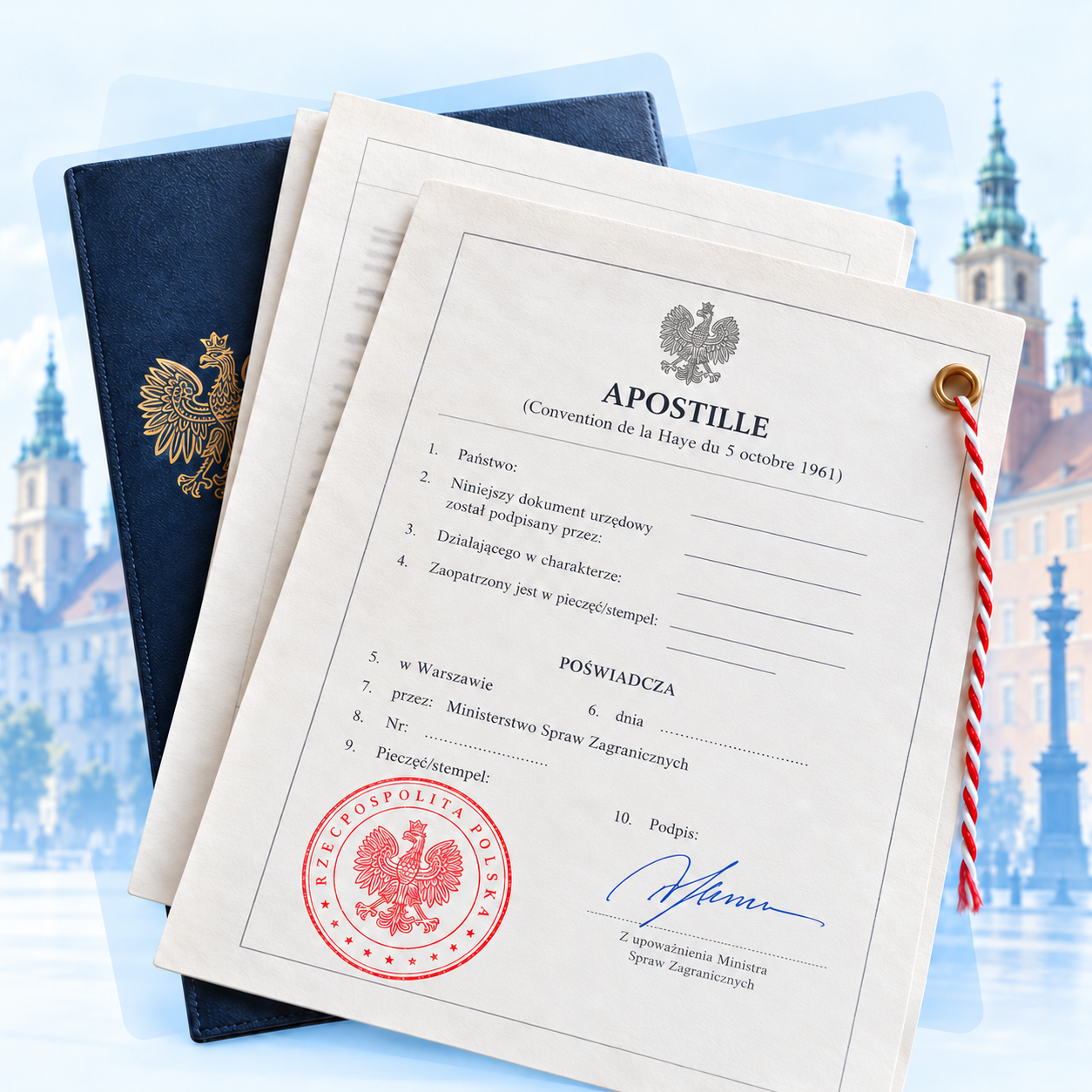
Basic
290 zł
Order an apostille
✓Submission to the Ministry of Foreign Affairs
✓Obtaining the apostille
✓Official fee of 60 zł included
Prices cover one eligible document at the MSZ stage. The PLN 60 official fee is included.
3–4 business days, 2 business days and 24 hours refer to the selected MSZ stage. Obtaining a court copy, prior authentication, translation and additional postage are agreed separately. Overall timing includes preparation, the necessary steps and receipt of the result.
We’re always available—contact us conveniently via WhatsApp, Telegram, and other messengers. We respond quickly and keep you updated at every stage.
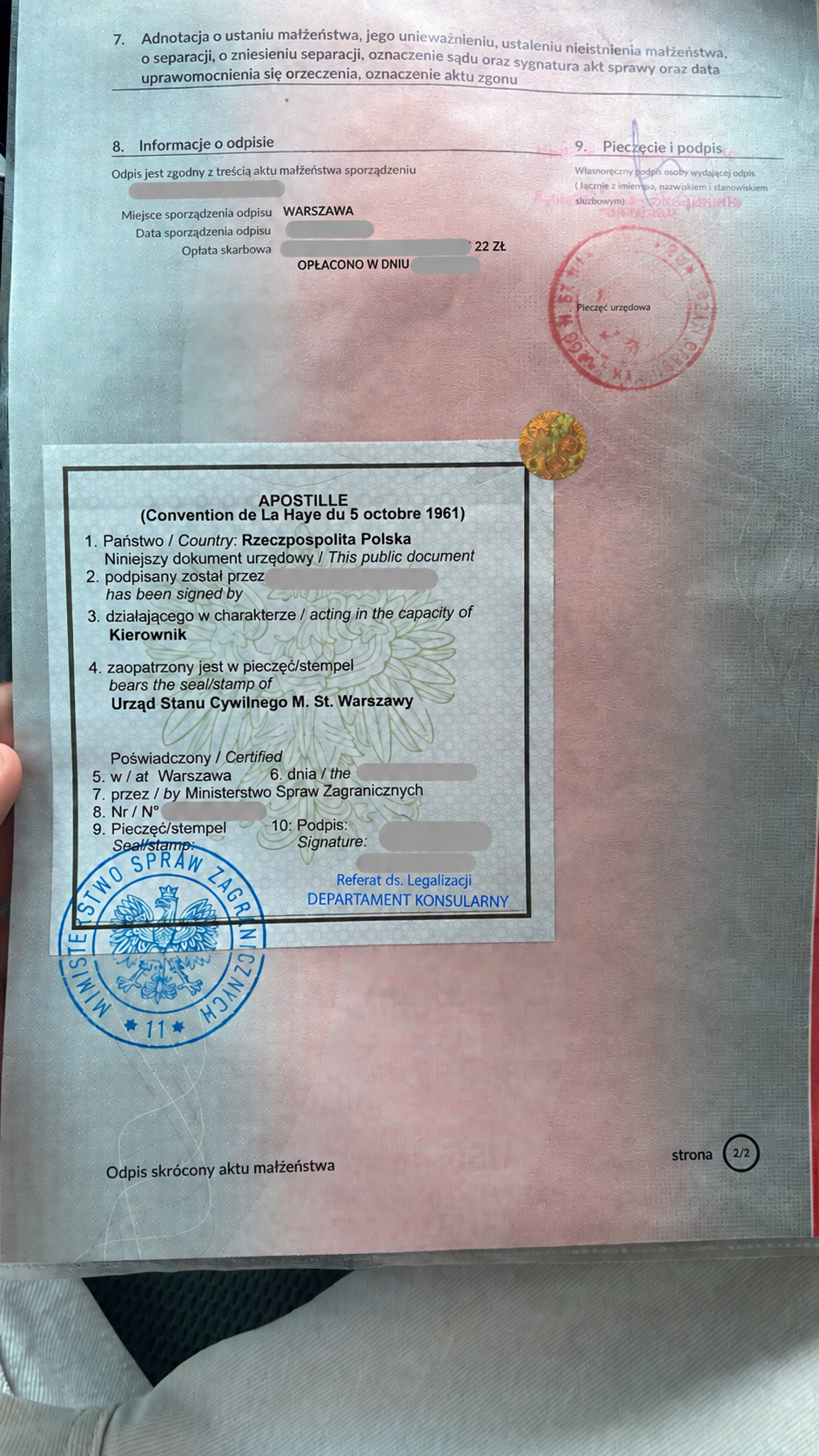
Birth certificate apostille
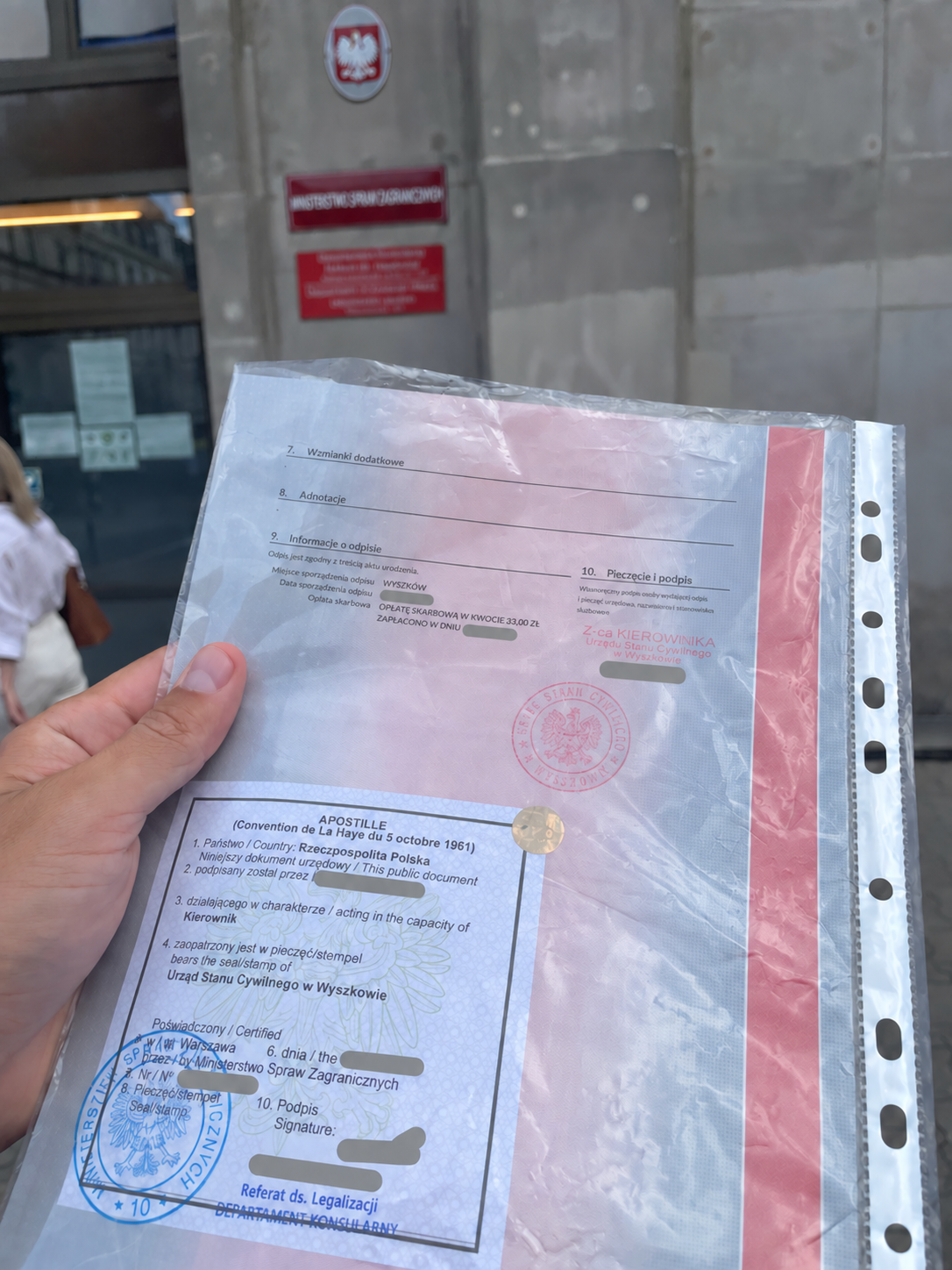
Apostille on a notarised copy
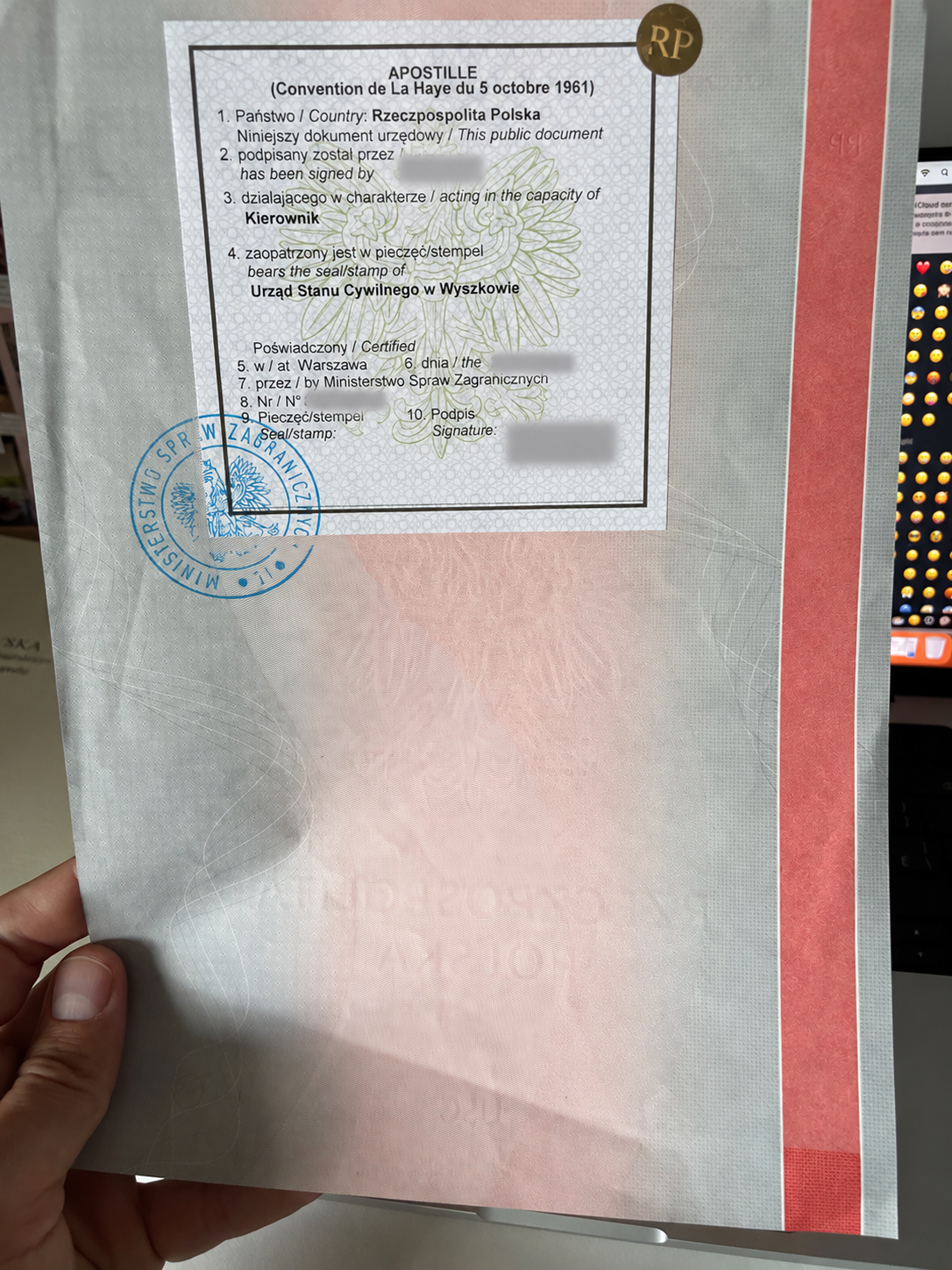
Marriage certificate apostille
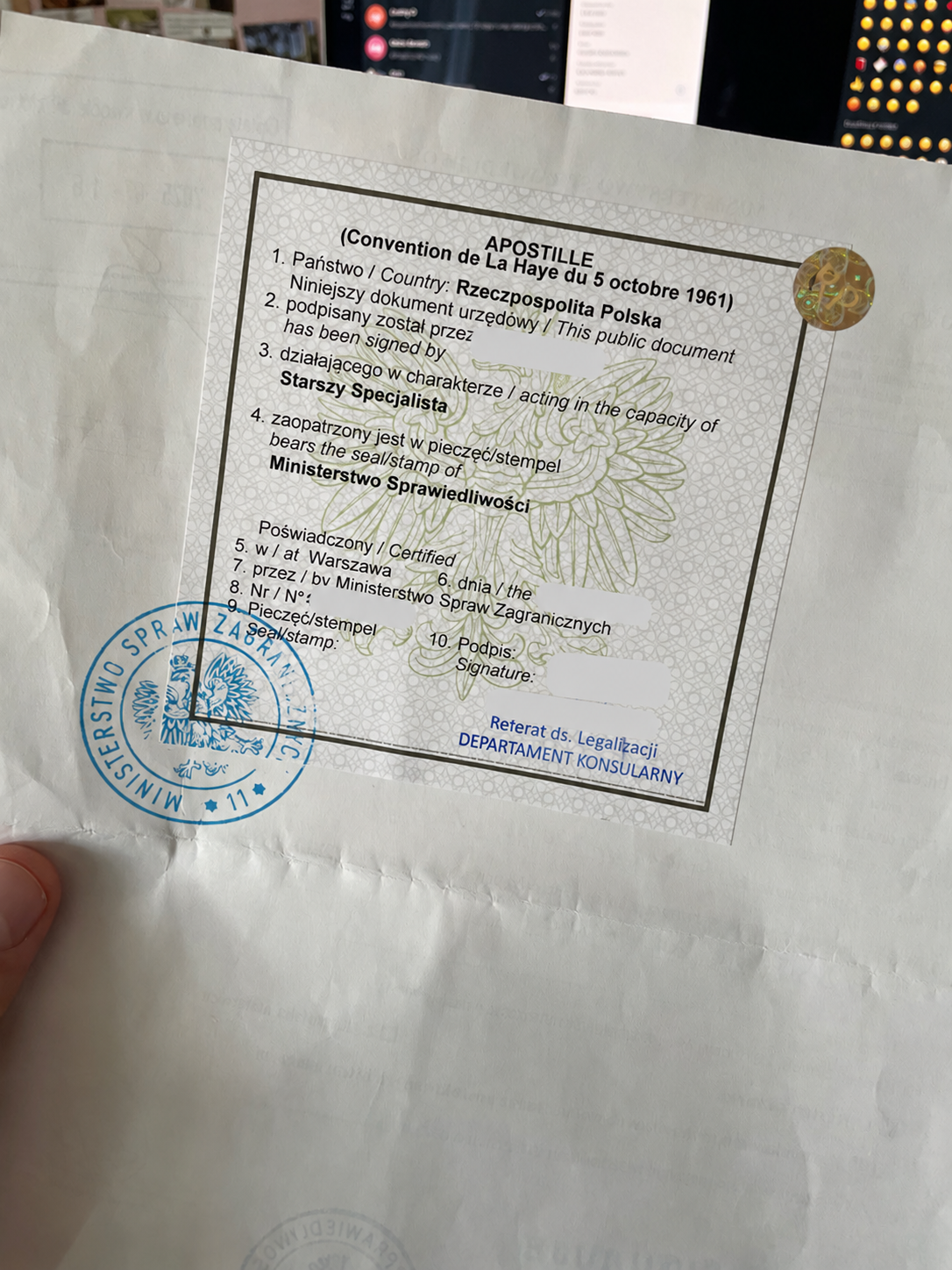
Criminal record certificate apostille
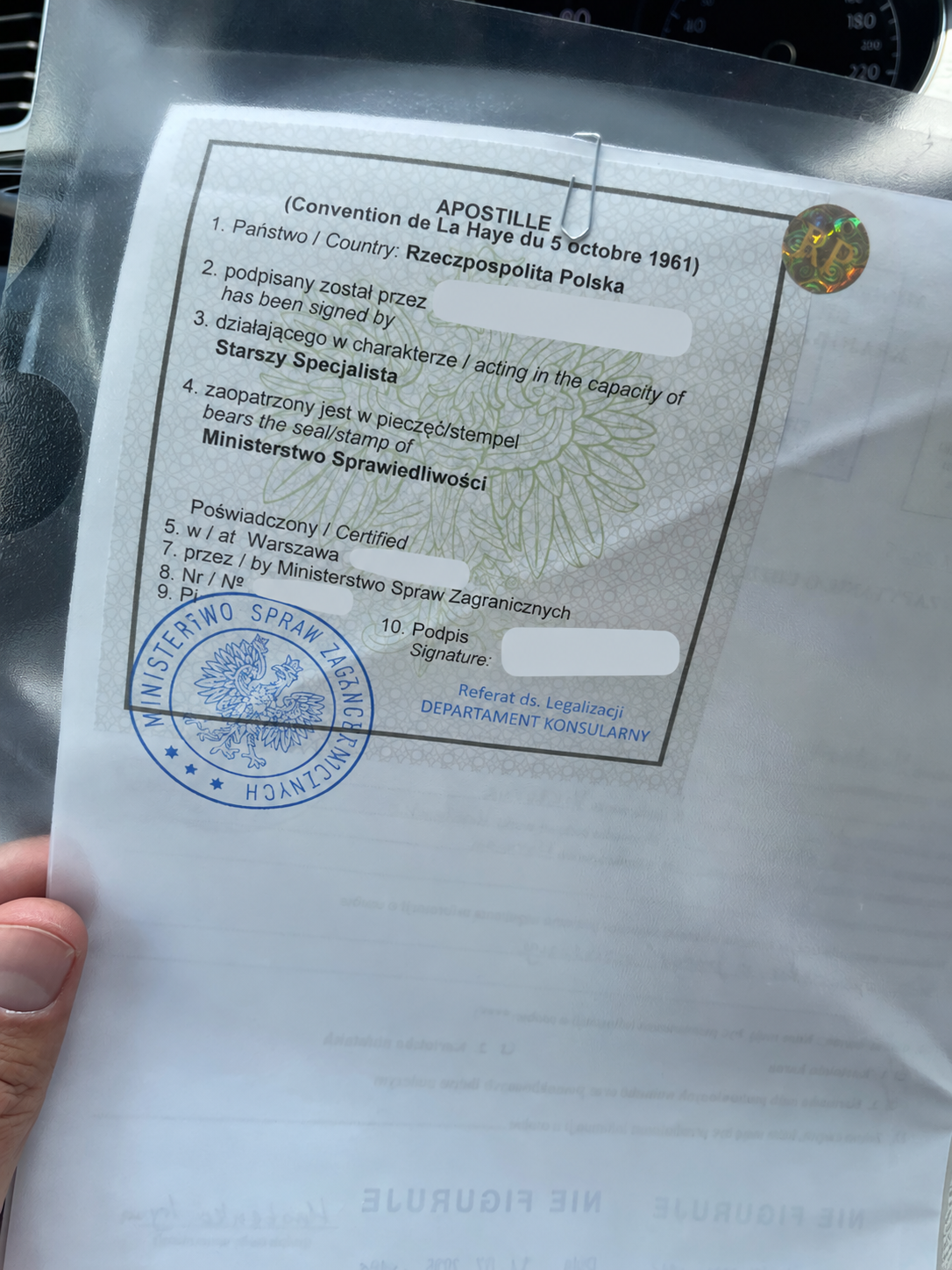
Court judgment apostille
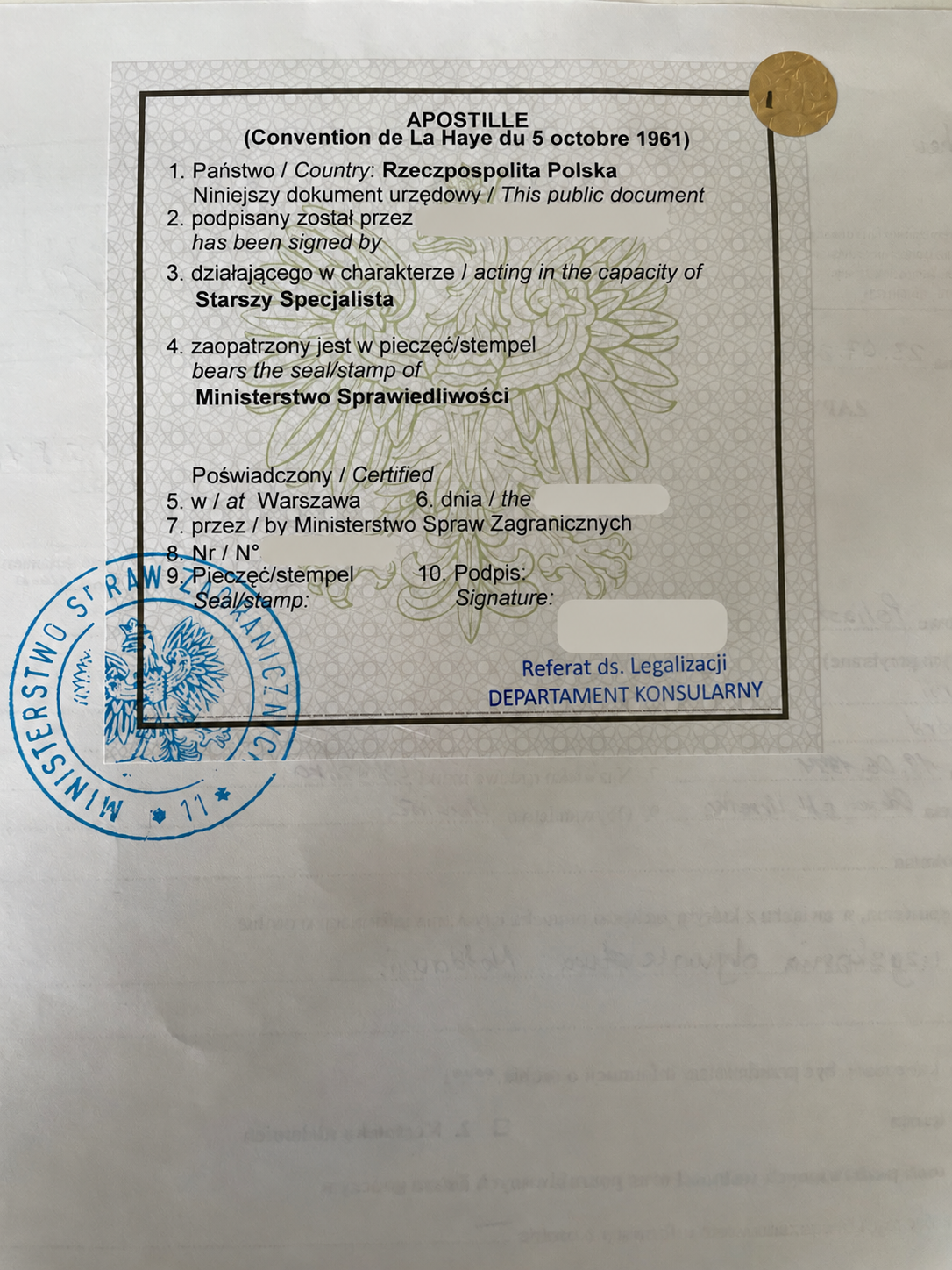
Apostille on an official document
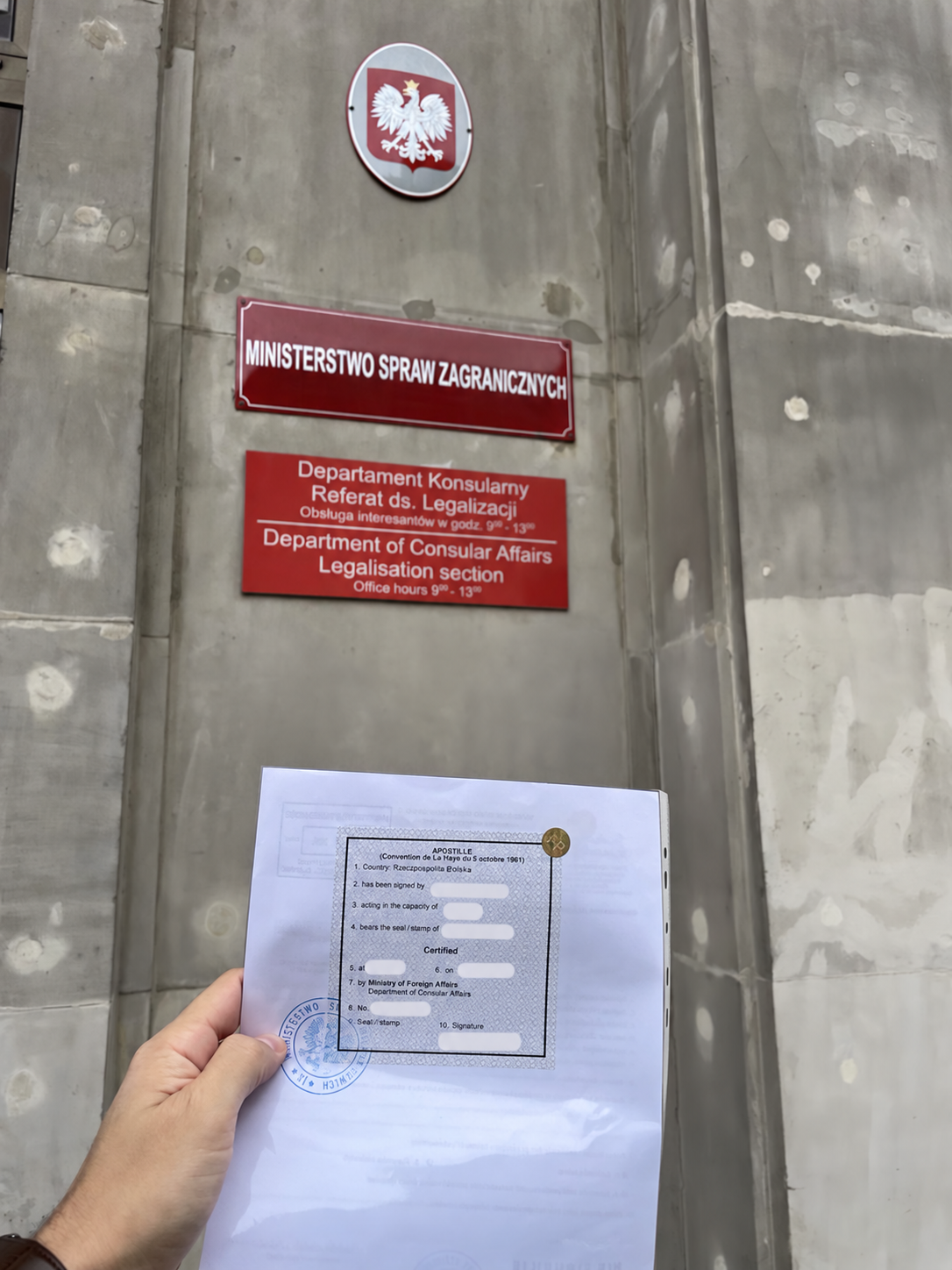
Criminal record certificate apostille
Notarial power of attorney apostille
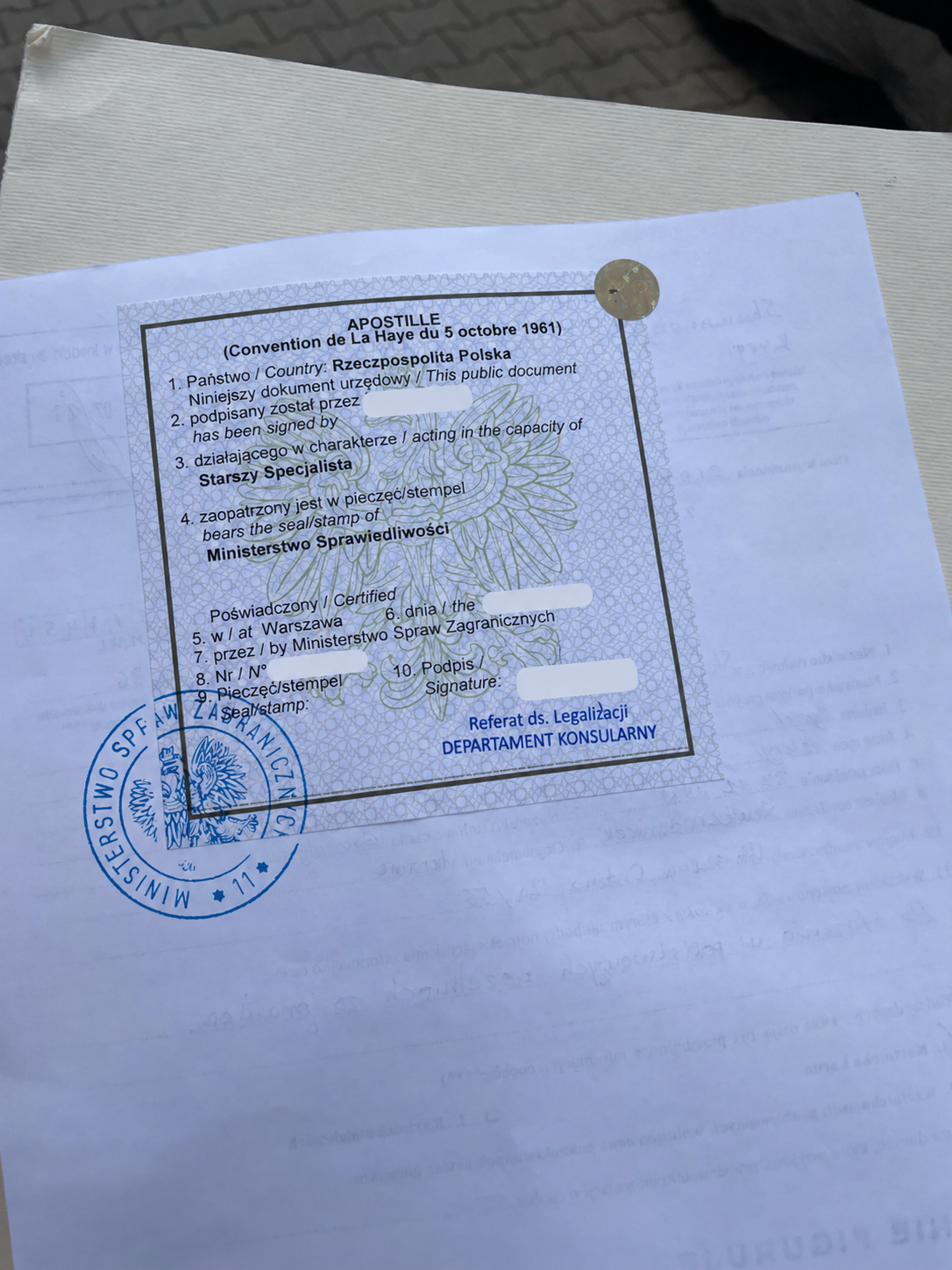
Example of an apostille on a client's document
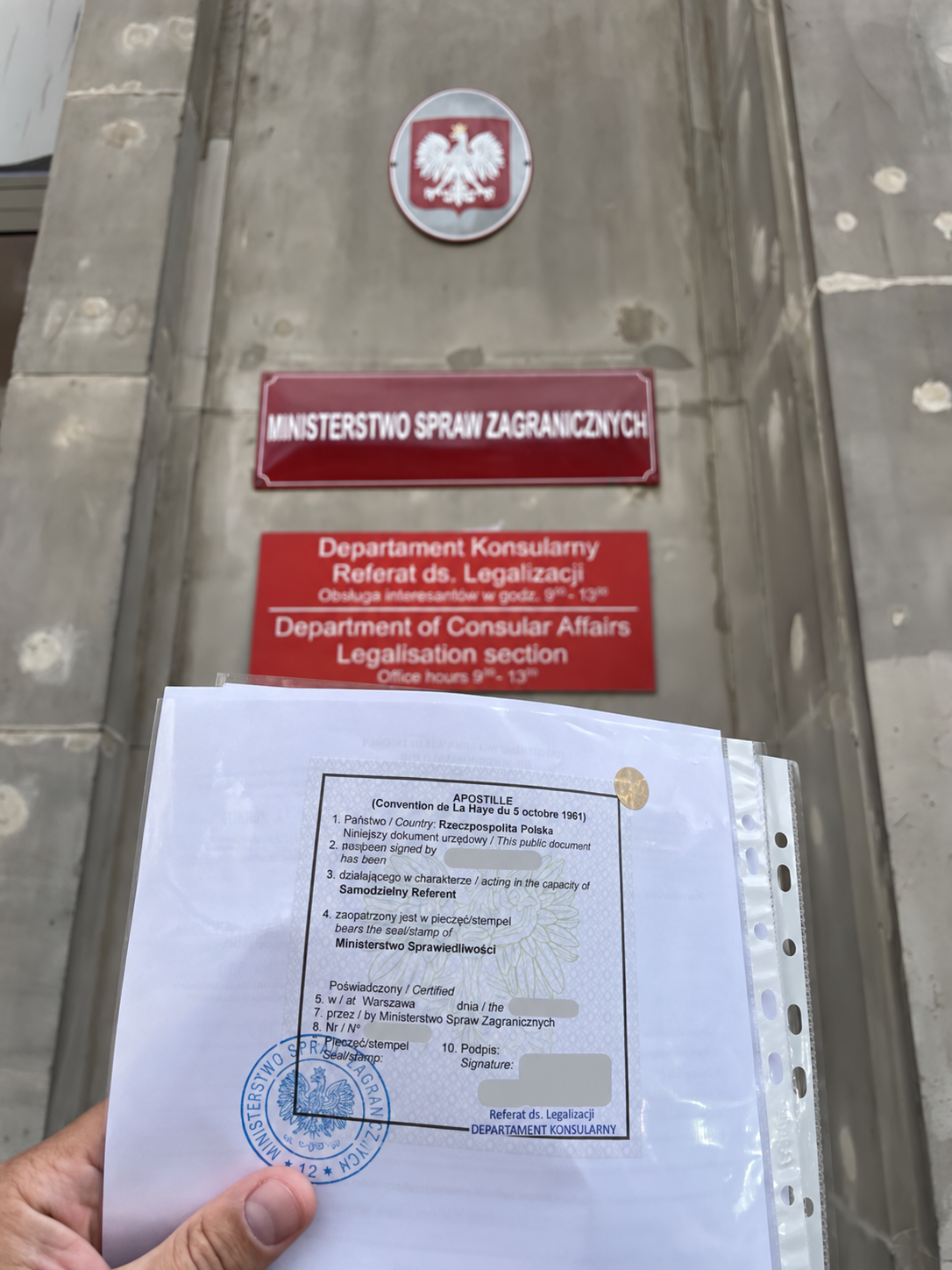
Example of an apostille on a client's document
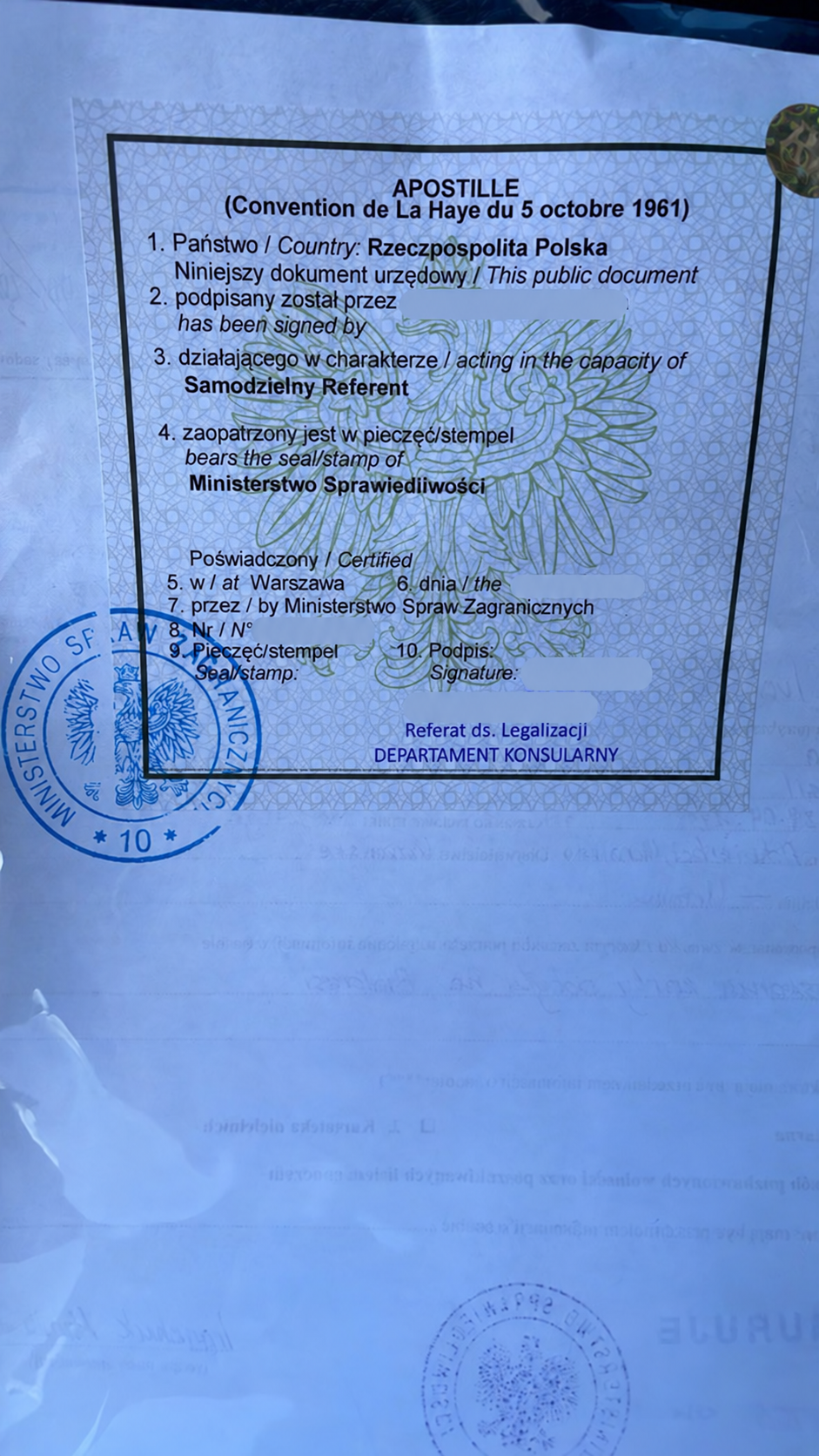
Example of an apostille on a client's document
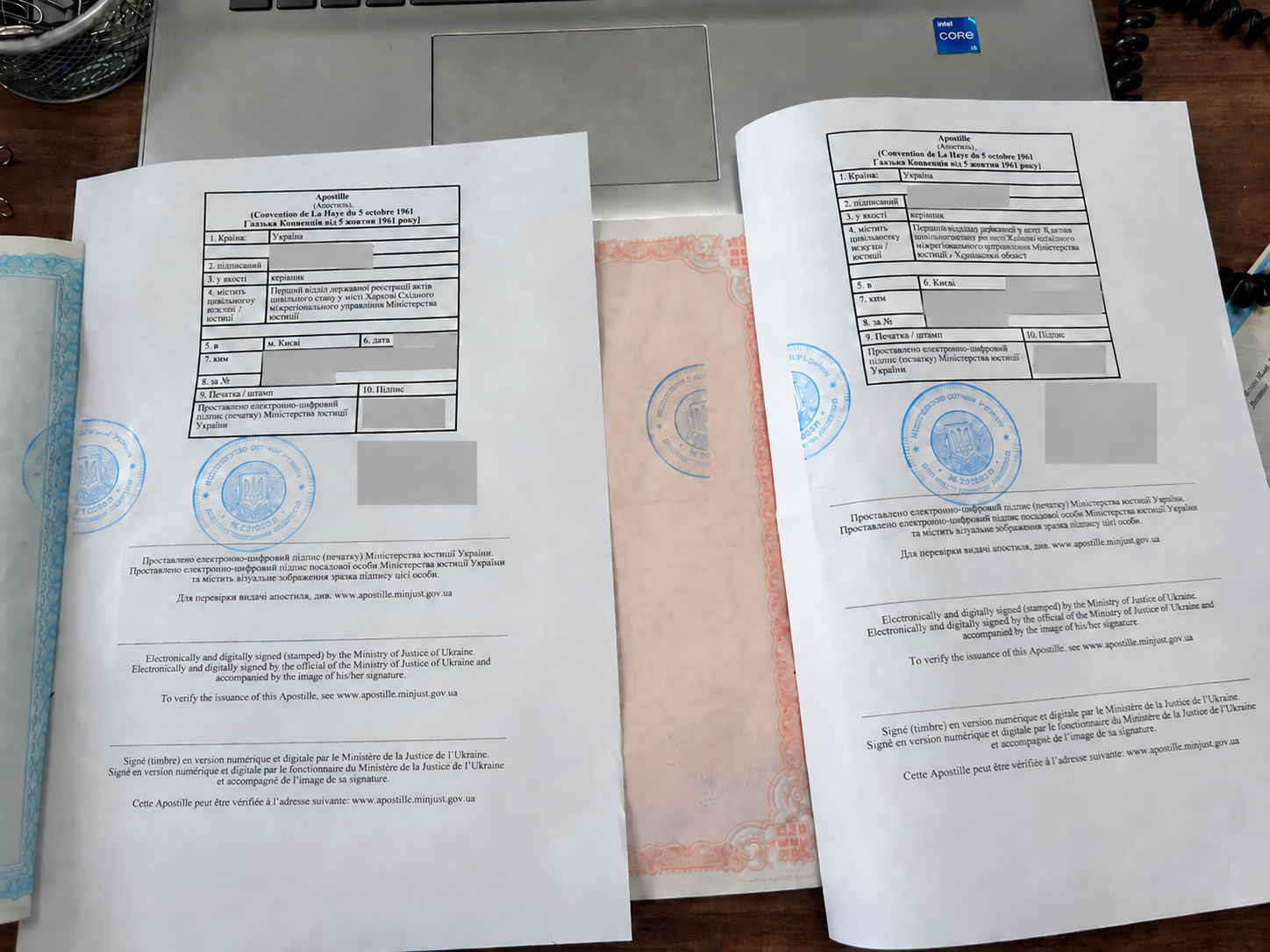
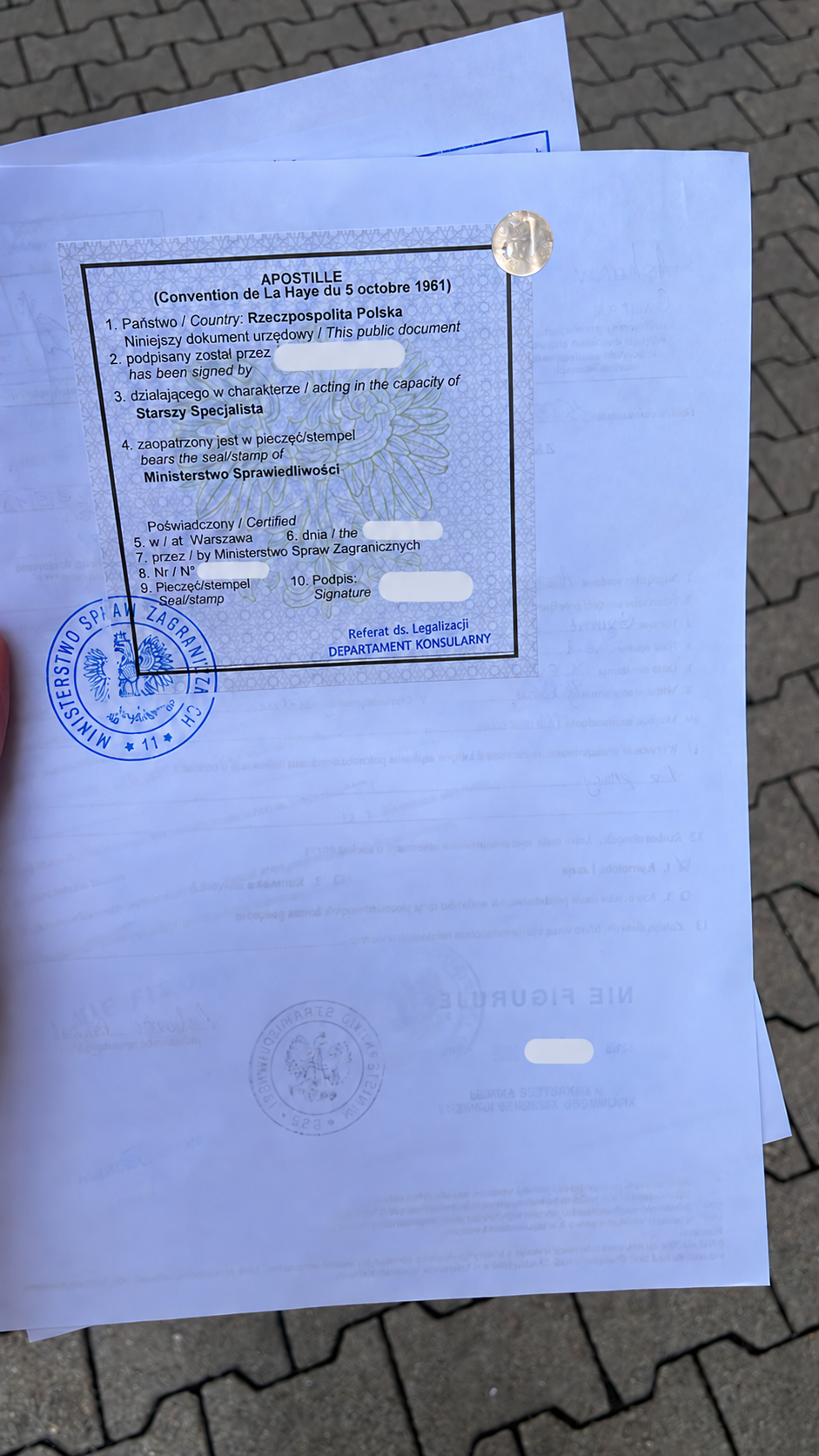
Example of an apostille on a client's document
I contacted the Translait Service office to obtain an apostille for the document. The bureau employee answered me very…I contacted the Translait Service office to obtain an apostille for the document. The bureau employee answered me very quickly. The quality of service is at the highest level. The staff is very attentive. The apostille was issued exactly on time. I recommend contacting this office
From Kazakhstan I applied to this bureau for a certificate of good conduct with an apostel. Everything was done quickly…From Kazakhstan I applied to this bureau for a certificate of good conduct with an apostel. Everything was done quickly and efficiently. And they sent the original to Kazakhstan. Marek Abukhovich worked with me on communications all the time. Many thanks to him. We made a certificate to...
I ordered police clearance certificates with an apostille for two people, applied on Thursday, and everything was rea…I ordered police clearance certificates with an apostille for two people, applied on Thursday, and everything was ready on Monday. The original can be obtained in Poland through Inpost, they also send a high-quality scan. Very convenient and fast! Thanks a lot!
I contacted this company for the first time. I ordered a police clearance certificate in Poland with an Apostille. Very…I contacted this company for the first time. I ordered a police clearance certificate in Poland with an Apostille. Very competent staff. Everything was done quickly. Received excellent advice on all issues. Sent by mail. I recommend it.
Hello! I ordered a police clearance certificate with an apostille. The next day I was ready. DHL delivery to Kazakhstan…Hello! I ordered a police clearance certificate with an apostille. The next day I was ready. DHL delivery to Kazakhstan took another six days. This is great! To be honest, from the very beginning I didn’t really believe in this event, but the impossible is possible! Great!!!
We ordered a certificate of good conduct with an apostille, in two days everything was ready and sent to the required add…We ordered a certificate of good conduct with an apostille, in two days everything was ready and sent to the required address! 5 stars!
I recommend quickly and qualitatively 😌 …
I have used their services many times, I am very satisfied, they always come to my aid in any situations and difficulties…I have used their services many times, I am very satisfied, they always come to my aid in any situations and difficulties, they will advise you as best as possible, everything is done very quickly and efficiently, I recommend them wholeheartedly))
Thank you very much for your help, you solved my issue very quickly and efficiently, and advised me how to get my document…Thank you very much for your help, you solved my issue very quickly and efficiently, and advised me how to get my documents delivered quickly and cheaply!!! I recommend this company to everyone)
Thank you for your service! Very prompt. Good price!
Start with a description of the task or one document; a complete set is not needed for your first enquiry. Tell us the known countries and purpose in a message or follow-up conversation. A scan is optional.
What is clarified before work starts
If you do not know when proceedings began, which certificate is needed or how finality is confirmed, say so. These details can be clarified after the initial enquiry.
Before ordering, establish what work is covered, what is included in the cost, when the timeline starts and how documents are returned. Recognition, a USC entry and enforcement are not included simply because an apostille is ordered.
The procedure depends on the document's country of origin and its recipient. Living in Poland does not turn a foreign judgment into a Polish document.
| Your situation | What determines the next step |
|---|---|
| A Polish court document for another country | Issuing court, overseas recipient, case type, relevant dates and purpose |
| A foreign court document for Poland | Country of the court, Polish recipient and applicable rules on recognition or use |
| A Polish document within Poland, or a foreign document for a third country | Clarify the purpose first; residence alone does not establish a route through Poland's MSZ |
Details about the judgment and its recipient
A Polish document abroad
Identify the court and destination country. The document may be needed as evidence, for a civil status record, for recognition or to recover money. These purposes can require different supporting documents.
A foreign document in Poland
Identify the country of the court and the Polish authority or organisation. A civil registry office — USC — and an enforcement procedure may apply different requirements.
Useful details include the case type, when proceedings began, the judgment date and its finality. For succession, the date of death also matters. Start with what you know.
A divorce judgment and a civil status certificate are different documents. For a certificate or registry extract, see apostilles for civil registry documents. Other document types are covered in the apostille section.
Not every judgment needs an apostille. The countries, document, purpose and exemptions must be checked first. An apostille authenticates the signature, the signer's capacity and the seal; it does not certify the judgment's substance.
| Outcome | Next step |
|---|---|
| An apostille is required | Check the suitable document and competent authority, then agree the work |
| An exemption applies | Prepare the remaining documents and translation without automatically ordering an apostille |
| A different procedure applies | Check legalisation or choose the service for the document you actually have |
| Information is missing | Clarify the countries, dates, case type or recipient's requirement |
| Case or document type | Conditions that affect the answer |
|---|---|
| Divorce, legal separation, marriage annulment and parental responsibility between participating EU states | Regulation 2019/1111 applies to proceedings instituted from 1 August 2022; Denmark does not participate. Covered documents are exempt. Maintenance, matrimonial property and succession fall outside this regime |
| Earlier family proceedings | Regulation 2201/2003 and transitional conditions must be checked. A judgment issued in 2024 does not bring proceedings started in 2021 into the newer regime |
| Civil or commercial proceedings | Regulation 1215/2012 covers cases within its scope instituted from 10 January 2015. Subject matter and territorial limits apply; Denmark and earlier cases need separate checks. Family, maintenance and succession matters must not be included automatically |
| Maintenance | Regulation 4/2009 applies from 18 June 2011, subject to transitional rules. Outside the relevant EU regime, the 2007 Convention may apply: countries, age, residence and application channel matter |
| Succession | Regulation 650/2012 concerns deaths on or after 17 August 2015; Denmark and Ireland do not participate. A later judgment date does not replace the death-date test |
| Listed EU public documents concerning personal status | Regulation 2016/1191 applies to presentation to an authority in another EU state from 16 February 2019. It does not cover every judgment, third-country documents and their EU-certified copies, or recognition of legal effects |
| European Small Claims Procedure | Check the actual procedure under Regulation 861/2007, applicable from 1 January 2009, its scope and participating states; Denmark is excluded. A low-value ordinary claim does not automatically qualify |
| Criminal, administrative or another special case | The label “court judgment” does not establish a route under the EU civil regulations; check the relevant procedure |
| A document between Poland and Ukraine | A treaty exemption applies to properly issued official documents. Translation and the required document set still need checking |
Exemptions and a disputed apostille requirement
The Hague Convention must apply between the particular countries and to the territory concerned. Finding a country on a general list is not enough. A treaty, national law or a special regime may remove the authentication requirement.
Legal bases: Hague Convention, Articles 1, 3–6 and 12; Regulations 2019/1111, 2201/2003, 1215/2012, 4/2009, 650/2012, 2016/1191, 861/2007 and the 2007 Maintenance Convention. For Poland and Ukraine, see the Polish consular guidance.
Documents from Russia, Belarus or the United Kingdom, older proceedings and documents from special courts require a case-specific check. The country's name alone does not establish a complete route.
If a recipient requests an apostille despite a possible exemption, ask for the exact written requirement and its legal basis before paying for additional authentication.
What matters is who issued the copy. A Polish court-issued copy — odpis — is an official document, distinct from a printout. You do not need to remove the sole original judgment from the court file.
| What you have | What to do |
|---|---|
| A court-issued odpis | Check its official particulars and suitability for authentication and the recipient |
| A notarised copy | First check whether it can replace a court-issued copy; the notarial certification is a separate act |
| An ordinary copy or printout | Use it for reference, rather than as the official document for the Polish procedure |
| A scan | Use it to start an enquiry; establish which proper document will be needed next |
| An electronic court document | Check its origin, signature and the procedure's rules; it is not the same as a scan |
Why a notarised copy is not an automatic substitute
Polish notarisation of a copy of a foreign judgment does not turn the foreign court signature into a Polish one. An apostille on that certification concerns the notarial act.
A translation or a copy certified by a translator does not automatically become a court-issued copy either. The Polish paper procedure requires a suitable document bearing the appropriate official particulars. Legal bases: authentication rules, §§ 20–22 and Article 9 of Poland's Code of Civil Procedure, KPC.
Finality, enforceability and an apostille serve different purposes. The document set depends on the intended use; finality is not a universal condition for every apostille.
| Purpose | Separate check |
|---|---|
| Establishing finality — prawomocność | Whether finality is apparent from the judgment or needs separate court confirmation |
| Seeking enforcement — wykonalność | Enforceability in the country of origin and the applicable enforcement procedure in the destination |
| Using a judgment under an EU regulation | The proper copy and the certificate for that particular regime |
| Relying on recognition under the general KPC regime | Recognition conditions and Article 1147 documents; special regimes and older judgments need a separate assessment |
| Updating a USC civil status record | The basis for recognition and document and translation requirements; an apostille alone does not secure the entry |
Finality, certificates and the general Polish regime
Finality
An apostille does not establish that a judgment is final. Confirmation for a Polish judgment follows court rules, including Articles 363–364 KPC.
Enforceability and the enforcement procedure
Recognition of legal effects and compulsory enforcement are not automatic results of apostille authentication. Under the general KPC regime, Articles 1145–1151 must be considered. Article 1147 provides for an official copy, confirmation of finality if it is not apparent from the judgment, and a certified Polish translation. Proof of service is required in the specified circumstances where the defendant did not participate.
That set does not apply to every EU procedure. For example, a matrimonial judgment under Regulation 2019/1111 uses the Article 36 certificate, Annex II. The Article 53 certificate under Regulation 1215/2012 and Form D for European Small Claims are not interchangeable.
In Polish civil proceedings, Article 1138 KPC does not impose general legalisation of all foreign public documents. Exceptions include the specified situations involving Polish immovable property and disputed authenticity. It is not a guarantee of acceptance by every bank or administrative authority.
Older judgments require consideration of the transitional rules for KPC changes effective from 1 July 2009. Legal bases: KPC, 2008 amending Act, Articles 8–9, and Civil Status Records Act, Article 108.
Polish court documents and foreign judgments follow different routes. The Polish steps below apply only after an apostille has been found necessary.
Who authenticates the document before MSZ
A Polish court-issued copy
Under § 20(1)(1)(a), authentication is performed by the president of the competent regional court — sąd okręgowy — or an authorised person. A document issued by the regional court itself also needs the prescribed prior authentication. Under § 20(1)(1)(b), an appeal court document is authenticated by that court's president or an authorised judge. Competence for special courts needs a separate check.
Legal basis: § 20 of the court authentication rules. See also apostilles for Polish documents.
A foreign judgment for use in Poland
If the foreign court document needs an apostille, the competent authority in its country of origin issues it. Poland's Ministry of Foreign Affairs — MSZ — does not apostille a foreign court signature.
Where an exemption applies, omit the apostille steps. If another authentication procedure is required, check consular legalisation. The Polish MSZ legalisation guidance is not a universal route for foreign judgments.
Obtaining a court copy, notarising a copy and authenticating a translator's signature are not compulsory stages of every order. The work to be performed is agreed separately.
Submit the proper document, application and proof of the applicable payment to MSZ.
The recipient and procedure determine the language, scope and acceptable certification. If the recipient requires the apostille to be translated, obtain the apostille before completing the translation of the relevant document set.
| Requirement | Sequence |
|---|---|
| Translation of the judgment and its apostille | Obtain the required apostille and include it in the completed translation |
| An apostille exemption applies | Translate the required documents without adding an unnecessary apostille stage |
| An apostille is separately required on a certified translation | First prepare the translation bearing the translator's signature; authentication of that signature does not replace authentication of the court document |
| Submission under an EU procedure | Check whether the whole judgment or only particular certificate information needs translation |
| Submission to a USC office | Check the permitted translation option under Article 31 of the Civil Status Records Act |
Translation scope and certification
When to translate the apostille
Work on the judgment's text can begin earlier. However, the completed translation must cover the issued apostille if the recipient requires it. An additional apostille on the translation, and any requirement to translate that apostille, need separate checks. There is no compulsory double-apostille package for every judgment.
Sworn translation and notarisation
A sworn translation is certified by an authorised translator. For something described as a “notarised translation”, establish who translated it and what the notary certified. The terms are not equivalent.
The translation identifies the source document. Translating a scan does not turn it into a court original. For USC submissions, the law provides options involving a Polish sworn translator, an authorised EU/EEA translator or a consul, subject to the statutory conditions.
Legal bases: Sworn Translators Act, Articles 13 and 18, Civil Status Records Act, Article 31, and the applicable EU regulation's translation rules. Service: sworn translation for the document recipient.
The total cost depends on the agreed work. Official fees are separate from company charges, and an authority's processing time is separate from the time needed to receive the complete result. Official fee rates checked on 14 October 2026.
| Service | Cost | Timing |
|---|---|---|
| Polish MSZ apostille, if required | Standard official fee: 60 zł per authenticated document; check any fee exemption | Authority processing after preparation and submission |
| Applicable prior authentication or legalisation | Standard legalisation fee: 26 zł where applicable; the operation and any exemption need separate checks | Depends on the authority and readiness of the document |
| Court-issued copy and supporting confirmations | Possible separate charges for the required documents | Depends on obtaining the documents and the necessary authority to act |
| Company services, translation and return | Scope, included expenses and separate payments are agreed in the estimate | Total time is agreed taking all required stages into account |
Standard official fee: 60 zł per authenticated document; check any fee exemption
Authority processing after preparation and submission
Standard legalisation fee: 26 zł where applicable; the operation and any exemption need separate checks
Depends on the authority and readiness of the document
Possible separate charges for the required documents
Depends on obtaining the documents and the necessary authority to act
Scope, included expenses and separate payments are agreed in the estimate
Total time is agreed taking all required stages into account
What affects the estimate and completion date
The full timeline may include obtaining a missing copy, court authentication, access to submission, authority processing, translation and return. Its starting point is agreed with the order.
The MSZ guidance states up to 30 days for postal applications from receipt by the ministry. Processing during an appointment may be possible with prepared documents. Neither is the turnaround for the whole order.
Fees are set by the Stamp Duty Act, Schedule II.5–6. Exemption from authentication and exemption from a fee are different. Statutory relief in maintenance, guardianship and other specified matters must be checked. Adding the two standard fees does not give a universal total price.
If you have a submission deadline, tell us before agreeing the order. Urgent arrangements and whether the deadline can be met need confirmation for your case.
Paper handover and authority to act depend on the task. Obtaining a court copy, prior authentication and submission to MSZ need separate checks. Agree the return method before sending documents.
| Method | What to check |
|---|---|
| Submission or collection in person at MSZ | Appointment, complete submission documents and authority of the person acting |
| Postal return by MSZ | Registered post only to Poland, EU states, Iceland, Liechtenstein, Norway or Switzerland; for other circumstances, check whether a representative for service in Poland is required |
| Handover and return through the company | Available method, address, cost, tracking and responsibility for the particular order |
Authority to act and the returned document set
Permission to submit an MSZ application does not automatically authorise collection of court documents or representation in proceedings. Agree who performs each task and what authority is needed before handover.
The official submission and return rules are on the MSZ page. Handover to the company is a separate arrangement.
Specify the return of the court document, supporting confirmations and required translation. An electronic copy of the result does not replace the paper document where the recipient requires paper.
If the document is rejected, establish why first. Another apostille will not correct the judgment's substance, missing finality confirmation or an unsuitable translation.
What to do if there is a doubt or rejection
Ask for the precise reason: the copy, translation, finality, recognition, enforcement or substance. That determines the next action.
The issuing competent authority can check an apostille against its register under Article 7 of the Hague Convention. Not every country provides a public online register.
A refund of official stamp duty for an act not performed under Article 9 of the Stamp Duty Act is not a guarantee of reimbursement of company charges.
Sources for the procedures and limitations described. The particular recipient’s requirements are checked for your situation.


